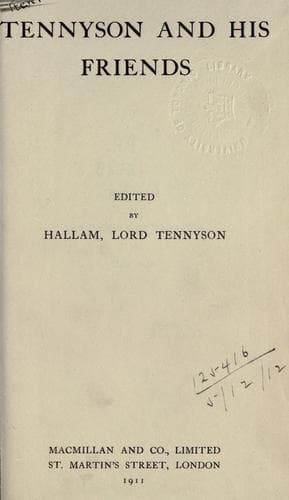
Tennyson, Alfred Tennyson, Baron, 1809-1892 -- Friends and associates
Not less, tho' dogs of Faction bay,
Would serve his kind in deed and word,
Certain, if knowledge bring the sword,
That knowledge takes the sword away.
The last couplet seems to me--where all is powerful and imaginative--to be
a master-stroke of terse and pointed expression. It would be hardly an
exaggeration to say that it sums up human history in regard to one
point--namely, the disturbing and even desolating effect of the new
Political Idea, until its triumph comes, bringing a higher and more stable
adjustment, and a peace more righteous and secure.
Far more widely known than these didactic poems, rich as they are in
poetry and thought, are the patriotic odes--the three greatest being the
poems on the Duke of Wellington, the "Revenge," and Lucknow.
The ode on the Duke is a noble commemoration-poem, grave and stately and
solemn--a worthy expression of "the mourning of a mighty nation" with a
musical and dignified sorrow--a terse and vivid reference to the Duke's
exploits--a fine imaginative passage where he pictures the dead Nelson
asking who the newcomer is, and the stately answer--a striking tribute to
the simple and noble character of the dead hero--and then this:
A people's voice! we are a people yet.
Tho' all men else their nobler dreams forget,
Confused by brainless mobs and lawless Powers;
Thank Him who isled us here, and roughly set
His Briton in blown seas and storming showers...
O Statesmen, guard us, guard the eye, the soul,
Of Europe, keep our noble England whole,
And save the one true seed of freedom sown
Betwixt a people and their ancient throne...
For, saving that, ye help to save mankind
Till public wrong be crumbled into dust,
And drill the raw world for the march of mind,
Till crowds at length be sane and crowns be just.
Again, for the judgment of the poem, the _date_ is important. It was
written only four years after the European earthquake of 1848, and only
one year after the Coup d'État. The allusions are not mere commonplaces:
they deal with live issues. It is not too much to say that in the great
ode Tennyson had a subject after his own heart, and that he has done it
magnificent justice.
Of the "Revenge" I will quote one passage, because it contains what always
strikes me as _the_ most wonderful effect of _sound_ in poetry to be found
anywhere. The whole poem, I may observe, is full of novel and effective
handling of metre: but this is the most remarkable. It occurs in the
description of the rising storm in which the gallant little ship went
down:
Public-domain text, read in full here on John Shaqi.
Reviews
Reviews
No reviews yet
Be the first to share your thoughts on this work.
Elsewhere in the archive
Join the Discussion
Join the discussion
Sign in to leave a comment or review.
Sign InorCreate an account