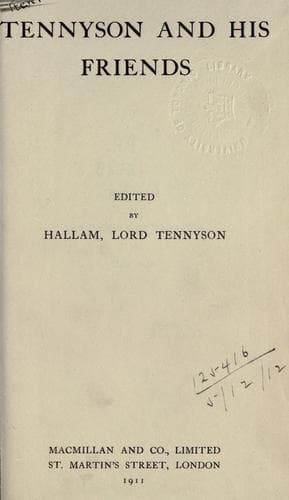
Tennyson, Alfred Tennyson, Baron, 1809-1892 -- Friends and associates
Certain critics have found fault with the splendid description of Dawn, as
being untrue to nature; a lover in such a crisis, they think, would not be
concerned with such images. I regard this suggestion as wholly at fault.
The tragedy, the parting, has come to pass: the vision of dawn is a _hope_
for _her_, now that the new life, apart from each other, has to begin for
both of them. If the broken love was all, if they could not look beyond,
the parting would have been different--like Lancelot and
Guinevere--"Stammering and staring; a madness of farewells." But here the
note is higher. The passion barred from its issue rushes into new
channels, and the exalted mood finds its only adequate vent in the
rapturous vision of a future dawn, the symbol of his hopes for her, those
hopes into which his sacrificed love is translated.
In the political poems we have a new departure. It is easy to idealize
freedom, revolution, or war: and the ancients found it easy to compose
lyrics on kings, athletes, warriors, or other powerful persons. From the
days of Tyrtaeus and Pindar, to Byron, Shelley, and Swinburne, one or
other of these themes has been the seed of song. But the praise of ordered
liberty, of settled government, of political moderation, is far harder to
idealize in poetry. It has been the peculiar aim of Tennyson to be the
constitutional, and in this sense the national, poet: and it is his
peculiar merit and good fortune to have succeeded in giving eloquent and
forcible expression to the ideas suggested by these aims.
I will not quote the poems about "the Falsehood of extremes," or "the land
of just and old renown where freedom slowly broadens down from precedent
to precedent," because these poems, terse and forcible summaries as they
are, have suffered, like other epigrammatic maxims in verse, from
vulgarizing quotation. It is not the Poet's fault in the least; in fact it
is due to his very merits--to the memorable brevity, truth, and point of
the phrasing. I will quote another--perhaps the most remarkable--of these
political poems, "Love thou thy land." It is close packed with thought,
and must have been especially hard to write, since the Poet's problem was
to express in terse and picturesque and imaginative language what at
bottom is philosophic and even prosaic detail. Nevertheless, where the
material lends itself at all to imaginative handling we get effects that
are impressive and even superb. Take a few lines--I cannot quote at
length:
Oh yet, if Nature's evil star
Drive men in manhood, as in youth,
To follow flying steps of Truth
Across the brazen bridge of war--
If New and Old, disastrous feud,
Must ever shock, like armed foes,
And this be true, till Time shall close,
That Principles are rain'd in blood;
Not yet the wise of heart would cease
To hold his hope thro' shame and guilt,
But with his hand against the hilt,
Would pace the troubled land, like Peace;
Public-domain text, read in full here on John Shaqi.
Reviews
Reviews
No reviews yet
Be the first to share your thoughts on this work.
Elsewhere in the archive
Join the Discussion
Join the discussion
Sign in to leave a comment or review.
Sign InorCreate an account