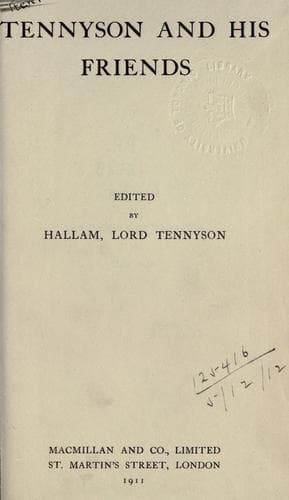
Tennyson, Alfred Tennyson, Baron, 1809-1892 -- Friends and associates
I know you cannot read German: the more interesting is it to trace in
your "Summer Oak" a beautiful kindred to something that is best in
Goethe; I mean his "Müllerin" (Miller's daughter) chiefly, with whom
the very Mill-dam gets in love; though she proves a flirt after all,
and the thing ends in satirical lines! Very strangely, too, in the
"Vision of Sin" I am reminded of my friend Jean Paul. This is not
babble, this is speech; true deposition of a volunteer witness. And so
I say let us all rejoice somewhat. And so let us all smite
rhythmically, all in concert, "the sounding furrows," and sail forward
with new cheer "beyond the sunset" whither we are bound.
The _Memoir_ contains some valuable reminiscences of this period,
contributed after Tennyson's death by his personal friends, which
incidentally throw backward a light upon the literary society of that day.
Mr. Aubrey de Vere describes a meeting between Tennyson and Wordsworth;
and relates also, subsequently and separately, a conversation with
Tennyson, who was enthusiastic over the songs of Burns: "You forget, for
their sake, those stupid things, his serious pieces." The same day Mr. de
Vere met Wordsworth, who "praised Burns even more vehemently than
Tennyson had done ..." but ended, "of course I refer to his serious
efforts, those foolish little amatory songs of his one has to forget."
But in addition to contemporary criticism, written or spoken, and to the
reminiscences, the biography gives us also several unpublished poems and
fragmentary verses belonging to this period, with the original readings of
other pieces that were altered before publication. It is in these
materials, beyond others, that we can observe the forming and maturing of
his style, the fastidious taste which dictated his rejection of work that
either did not satisfy the highest standard as a whole, or else marred a
poem's symmetrical proportion by superfluity, over-weight, or the undue
predominance of some note in the general harmony. One may regret that some
fine stanzas or exquisite lines should have been thus expunged, as, for
example, those beginning:
Thou may'st remember what I said.
Public-domain text, read in full here on John Shaqi.
Reviews
Reviews
No reviews yet
Be the first to share your thoughts on this work.
Elsewhere in the archive
Join the Discussion
Join the discussion
Sign in to leave a comment or review.
Sign InorCreate an account