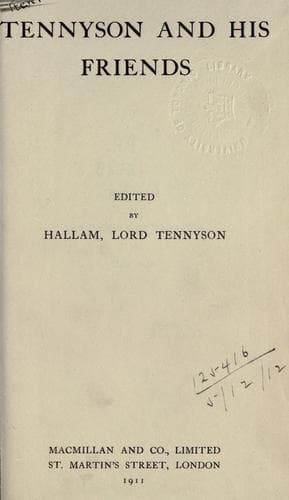
Tennyson, Alfred Tennyson, Baron, 1809-1892 -- Friends and associates
In November 1850, after Wordsworth's death, the Laureateship was offered
to Tennyson. We have good authority for stating, though not from this
_Memoir_, that Lord John Russell submitted to the Queen the four names of
Professor Wilson, Henry Taylor, Sheridan Knowles, and, last on the list,
Tennyson. The Prince Consort's admiration of "In Memoriam" determined Her
Majesty's choice, which might seem easy enough to those who measure the
four candidates by the standard of to-day. His accession to office brought
down upon Tennyson, among other honoraria, "such shoals of poems that I am
almost crazed with them; the two hundred million poets of Great Britain
deluge me daily. Truly the Laureateship is no sinecure." For the
inevitable levee he accepted, not without disquietude over the nether
garment, the loan of a Court suit from his ancient brother in song,
Rogers, who had declined the laurels on the plea of age. Soon afterward he
departed with his wife for Italy. Under the title of "The Daisy" he has
commemorated this journey in stanzas of consummate metrical form, with
their beautiful anapæstic ripple in each fourth line, to be studied by all
who would understand the quantitative value (not merely accentual) and
rhythmic effects of English syllables. On returning, they met the
Brownings at Paris. Then, in 1852, he bought Farringford in the Isle of
Wight, the Poet's favourite habitation ever afterward, within sight of
the sea and within sound of its rough weather, with its lawns, spreading
trees, and meadows under the lee of the chalk downs, that have been
frequently sketched into his verse, and will long be identified with his
presence. There he worked at "Maud," morning and evening, sitting in his
hard, high-backed wooden chair in his little room at the top of the house,
smoking the "sacred pipes" during certain half-hours of strict seclusion,
when his best thoughts came to him.
From the final edition in 1851 of "In Memoriam" to "Maud" in 1853, which
Lowell rather affectedly called the antiphonal voice of the earlier poem,
the change of theme, tone, and manner was certainly great; and the public
seems to have been taken by surprise. The transition was from lamentation
to love-making; from stanzas swaying slow, like a dirge, within their
uniform compass, to an abundant variety of metrical movement, quickened by
frequent use of the anapæstic measure. The general reader was puzzled and
inclined to ridicule what he failed at once to understand; the ordinary
reviewer was either loftily contemptuous or indulged in puns and parodies;
the higher criticism was divided; but Henry Taylor, Ruskin, Jowett, and
the Brownings spoke without hesitation of the work's great merits. Mr.
Gladstone, whose judgment had been at first adverse, recanted, twenty
years later, in a letter that was published in his _Gleanings_, and that
now reappears in this _Memoir_:
Public-domain text, read in full here on John Shaqi.
Reviews
Reviews
No reviews yet
Be the first to share your thoughts on this work.
Elsewhere in the archive
Join the Discussion
Join the discussion
Sign in to leave a comment or review.
Sign InorCreate an account