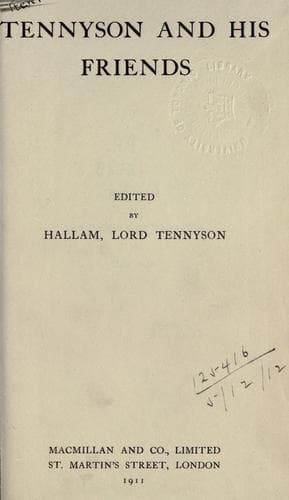
Tennyson, Alfred Tennyson, Baron, 1809-1892 -- Friends and associates
"Whether it is to be desired," he wrote, "that a poem should require
from common men a good deal of effort in order to comprehend it;
whether all that is put in the mouth of the Soliloquist in 'Maud' is
within the lines of poetical verisimilitude; whether this poem has the
full moral equilibrium which is so marked a characteristic of the
sister-works, are questions open, perhaps, to discussion. But I have
neither done justice in the text to its rich and copious beauties of
detail, nor to its great lyrical and metrical power. And, what is
worse, I have failed to comprehend rightly the relation between
particular passages in the poem and its general scope."
Jowett wrote:
No poem since Shakespeare seems to show equal power of the same kind,
or equal knowledge of human nature. No modern poem contains more lines
that ring in the ears of men. I do not know any verse of Shakespeare
in which the ecstasy of love soars to such a height.
On the other hand, an anonymous letter, which Tennyson enjoyed repeating,
ran thus:
SIR--I used to worship you, but now I hate you. I loathe and detest
you. You beast! So you've taken to imitating Longfellow.
Yours in aversion,
"----"
"I shall never forget," his son writes,
Tennyson's last reading of "Maud," on August 24, 1892. He was sitting
in his high-backed chair, fronting a southern window which looks over
the groves and yellow cornfields of Sussex toward the long line of
South Downs that stretches from Arundel to Hastings (his high-domed
Rembrandt-like head outlined against the sunset-clouds seen through
the western window). His voice, low and calm in everyday life, capable
of delicate and manifold inflection, but with "organ tones" of great
power and range, thoroughly brought out the drama of the poem.
"The peculiarity of this poem," Tennyson said, "is that different phases
of passion in one person take the place of different characters"; and the
effect of his own recitation was to set this conception in clear relief by
showing the connexion and significance of the linked monodies, combined
with a vivid musical rendering of a pathetic love-story. The emotional
intensity rises by degrees to the rapture of meeting with Maud in the
garden, falls suddenly to the depth of blank despair, and revives in an
atmosphere of energetic, warlike activity--the precursor of world-wide
peace.
Public-domain text, read in full here on John Shaqi.
Reviews
Reviews
No reviews yet
Be the first to share your thoughts on this work.
Elsewhere in the archive
Join the Discussion
Join the discussion
Sign in to leave a comment or review.
Sign InorCreate an account