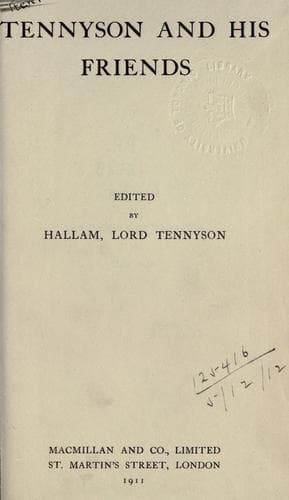
Tennyson, Alfred Tennyson, Baron, 1809-1892 -- Friends and associates
of all men and women in all times. But those who have no great skill at
deciphering the Hyponoia, the underlying significance, of the "Idylls" may
be pardoned for confessing to an occasional feeling of something abstract,
shadowy, and spectacular in the company of these knights and dames.[96]
FitzGerald, after reading the "Holy Grail," writes (1870) to Tennyson:
The whole myth of Arthur's Round Table Dynasty in Britain presents
itself before me with a sort of cloudy Stonehenge grandeur. I am not
sure if the old knights' adventures do not tell upon me better touched
in some lyrical way (like your "Lady of Shalott") than when elaborated
into epic form. I never could care for Spenser, Tasso, or even
Ariosto, whose epic has a ballad ring about it.... Anyhow, Alfred,
while I feel how pure, noble, and holy your work is--and whole
phrases, lines, and sentences of it will abide with me, and, I am
sure, with men after me--I read on till the "Lincolnshire Farmer" drew
tears from my eyes. I was got back to the substantial rough-spun
Nature I knew; and the old brute, invested by you with the solemn
humour of Humanity, like Shakespeare's Shallow, became a more pathetic
phenomenon than the knights who revisit the world in your other verse.
There! I cannot help it, and have made a clean breast.
If the extreme realism of some modern writers has been rightly condemned
as truth divorced from beauty, we may say that it has been by his skill in
maintaining their indissoluble union that Tennyson's best work shows its
peculiar strength and has earned its enduring vitality. He excels in the
verisimilitude of his portraiture, in the authentic delineation of
character, preserving the type and developing the main lines of thought
and action by imaginative insight, with high artistic fidelity in details.
I venture to anticipate that his short monodramatic pieces in blank
verse--his studies from the antique, like "Ulysses" and "Tithonus," and
his poems of English life, breathing the true idyllic spirit, like the
"Gardener's Daughter" and "Aylmer's Field"--will sustain their popularity
longer than the Arthurian Idylls. Nor can some of us honestly agree with
the unqualified praise bestowed by high authority (as the _Memoir_
testifies) on "Guinevere," where the scene between the king and the queen
at Almesbury, with all its elevation of tone and purity of sentiment, is
not very far from a splendid anachronism. But the epilogue "To the Queen,"
which closes the Arthurian epic, brings us back to modern thought and
circumstance by its ringing protest against faint-heartedness in English
politics.
Public-domain text, read in full here on John Shaqi.
Reviews
Reviews
No reviews yet
Be the first to share your thoughts on this work.
Elsewhere in the archive
Join the Discussion
Join the discussion
Sign in to leave a comment or review.
Sign InorCreate an account