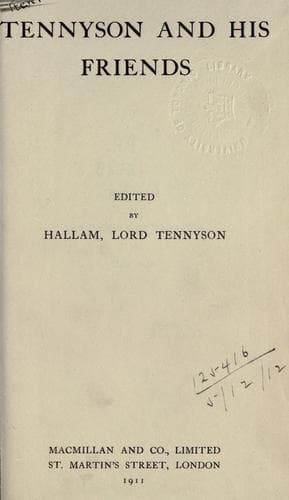
Tennyson, Alfred Tennyson, Baron, 1809-1892 -- Friends and associates
he has made the old legends his own, restored the idealism, and
infused into them a spirit of modern thought and of ethical
significance; setting his characters in a rich and varied landscape;
as indeed otherwise these archaic stories would not have appealed to
the world at large.
This indeed he has done well. And yet it is not possible to put away
altogether the modern prejudice against unreality, the sense of having
here a vision not merely of things that are past, but of things that could
never have been, of a world that is neither ancient nor modern, but a
fairy land peopled with knights and dames whose habits and conversation
are adjusted to the decorous taste of our nineteenth century. The time has
long passed when men could look back on distant ages much as they looked
forward to futurity, through a haze of unbounded credulity. Not every one
has been able to overcome the effect of incongruity produced by a poem
which invests the legendary personages of mediæval romance with morals and
manners of a fastidious delicacy, and promotes them to be the embodiment
of our own ethical ideals. If, indeed, we regard the "Idylls" as beautiful
allegories, we may be content, as their author was, with the suggestion
that King Arthur represents Conscience, and that the poem is "a picture of
the different ways in which men looked on conscience, some reverencing it
as a heaven-born king, others ascribing to it an earthly origin." We may
then be satisfied with learning, from the Poet himself, that "Camelot, for
instance, a city of shadowy palaces, is everywhere symbolic of the gradual
growth of human beliefs and institutions, and of the spiritual development
of man." In the light of these interpretations the poem is a beautifully
woven tissue of poetic mysticism, clothing the old legend of chivalry with
esoteric meaning. We can accept and admire it freely, remarking only that
the deeper thoughts of the present generation do not run in an allegorical
vein, and that such a vesture, though of the finest texture and
embroidery, waxes old speedily. "The 'Holy Grail,'" said Tennyson, "is
one of the most imaginative of my poems. I have expressed there my strong
feeling as to the reality of the Unseen"; and truly it is a marvellous
excursion into the field of mystical romance. But Tennyson also said that
"there is no single fact or incident in the 'Idylls,' however seemingly
mystical, which cannot be explained as without any mystery or allegory
whatever"; and herein lies our difficulty. For, unless they can be read as
wholly allegorical, there is an air of unreality about those enchanting
pictures, as of scenes and persons that could never have existed anywhere.
That Tennyson is a master of the art of veiling the lessons of real life
under a fairy story, we know from the subtle symbolism with which he
tells, in the "Lady of Shalott," the tale of sudden absorbing love,
hopeless and unregarded, sinking into despair--a true parable, understood
Public-domain text, read in full here on John Shaqi.
Reviews
Reviews
No reviews yet
Be the first to share your thoughts on this work.
Elsewhere in the archive
Join the Discussion
Join the discussion
Sign in to leave a comment or review.
Sign InorCreate an account