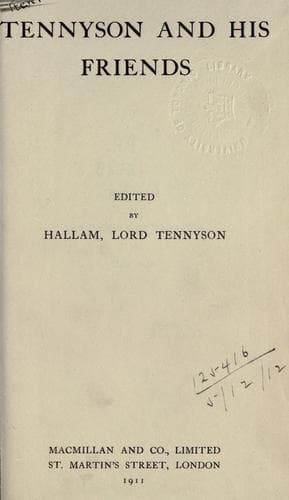
Tennyson, Alfred Tennyson, Baron, 1809-1892 -- Friends and associates
My uncle Frederick lived near St. Heliers, and my father and I visited
him (1887) in his house, overlooking the town and harbour of St.
Heliers, Elizabeth Castle, and St. Aubyn's Bay. The two old brothers
talked much of bygone days; of the "red honey gooseberry," and the
"golden apples" in Somersby garden, and of the tilts and tourneys they
held in the fields; of the old farmers and "swains"; of their college
friends; and of the waste shore at Mablethorpe: and then turned to
later days, and to the feelings of old age. My father said of
Frederick's poems that "they were organ-tones echoing among the
mountains." Frederick told Alfred as they parted that "not for twenty
years had he spent such a happy day."--_Tennyson: a Memoir, by his
Son._
To C. T.
True poet, surely to be found
When Truth is found again.
Of all the brothers of Alfred Tennyson the closest akin to him were
Frederick and Charles. The three were born in successive years, Frederick
in 1807, Charles in 1808, and Alfred in 1809. They slept together in a
little attic under the roof of the old white Rectory at Somersby, they
played together, read together, studied together under the guidance of
their father, and all three left home to go together to the school at
Louth, which Alfred and Charles at least held in detestation until their
latest years. Frederick was the first to break up the brotherhood, for,
in 1817, he left Louth for Eton, but to the end of his long life--he
outlived all his brothers--he seems to have looked back on the days of his
childhood through the medium of this fraternal trinity. Years afterwards
he wrote of their common submission to the influence of Byron, who "lorded
it over them, with an immitigable tyranny," and a fire at Farringford in
1876 brings to his mind the destruction of their Aunt Mary's house at
Louth, in the gardens of which he wrote: "I, and Charles, and Alfred,
enthusiastic children, used to play at being Emperors of China, each
appropriating a portion of the old echoing garden as our domain, and
making them reverberate our tones of authority."
Public-domain text, read in full here on John Shaqi.
Reviews
Reviews
No reviews yet
Be the first to share your thoughts on this work.
Join the Discussion
Join the discussion
Sign in to leave a comment or review.
Sign InorCreate an account