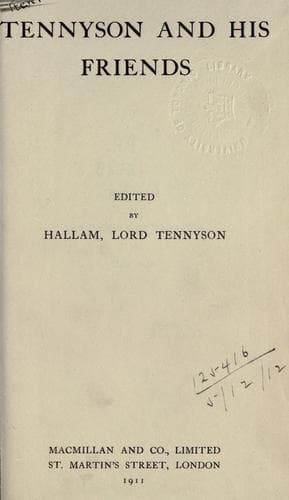
Tennyson, Alfred Tennyson, Baron, 1809-1892 -- Friends and associates
But this we may say, we know nothing of in all literature to compare with
the volume from which these lines are taken, since David lamented with
this lamentation: "The beauty of Israel is slain. Ye mountains of Gilboa,
let there be no dew, neither rain upon you. I am distressed for thee, my
brother Jonathan: very pleasant hast thou been unto me, thy love for me
was wonderful." We cannot, as some have done, compare it with
Shakespeare's sonnets, or with "Lycidas." In spite of the amazing genius
and tenderness, the never-wearying, all-involving reiteration of
passionate attachment, the idolatry of admiring love, the rapturous
devotedness, displayed in these sonnets, we cannot but agree with Mr.
Hallam in thinking "that there is a tendency now, especially among young
men of poetical tempers, to exaggerate the beauties of these remarkable
productions"; and though we would hardly say with him, "that it is
impossible not to wish that Shakespeare had never written them," giving
us, as they do, and as perhaps nothing else could do, such proof of a
power of loving, of an amount of _attendrissement_, which is not less
wonderful than the bodying forth of that myriad-mind which gave us Hamlet,
and Lear, Cordelia, and Puck, and all the rest, and indeed explaining to
us how he could give us all these;--while we hardly go so far, we agree
with his other wise words:--"There is a weakness and folly in all
misplaced and excessive affection"; which in Shakespeare's case is the
more distressing, when we consider that "Mr. W. H., the only begetter of
these ensuing sonnets," was, in all likelihood, William Herbert, Earl of
Pembroke, a man of noble and gallant character, but always of licentious
life.
As for "Lycidas," we must confess that the poetry--and we all know how
consummate it is--and not the affection, seems uppermost in Milton's mind,
as it is in ours. The other element, though quick and true, has no glory
through reason of the excellency of that which invests it. But there is no
such drawback in "In Memoriam." The purity, the temperate but fervent
goodness, the firmness and depth of nature, the impassioned logic, the
large, sensitive, and liberal heart, the reverence and godly fear, of
That friend of mine who lives in God,
which from these Remains we know to have dwelt in that young soul, give to
"In Memoriam" the character of exactest portraiture. There is no excessive
or misplaced affection here; it is all founded in fact: while everywhere
and throughout it all, affection--a love that is wonderful--meets us first
and leaves us last, giving form and substance and grace, and the breath of
life and love, to everything that the poet's thick-coming fancies so
exquisitely frame. We can recall few poems approaching to it in this
quality of sustained affection. The only English poems we can think of as
of the same order, are Cowper's lines on seeing his mother's portrait:
O that these lips had language!
Public-domain text, read in full here on John Shaqi.
Reviews
Reviews
No reviews yet
Be the first to share your thoughts on this work.
Elsewhere in the archive
Join the Discussion
Join the discussion
Sign in to leave a comment or review.
Sign InorCreate an account