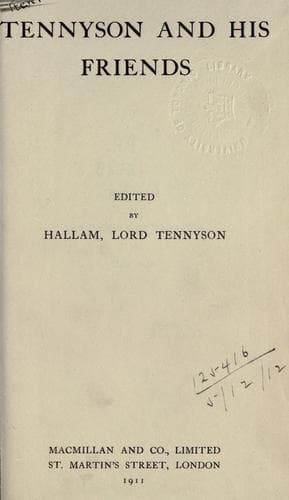
Tennyson, Alfred Tennyson, Baron, 1809-1892 -- Friends and associates
Burns' "To Mary in Heaven"; and two pieces of Vaughan--one beginning
O thou who know'st for whom I mourn;
and the other:
They are all gone into the world of light.
But our object now is, not so much to illustrate Mr. Tennyson's verses, as
to introduce to our readers, what we ourselves have got so much delight,
and, we trust, profit from--_The Remains in Verse and Prose, of Arthur
Henry Hallam_, 1834; privately printed. We had for many years been
searching for this volume, but in vain; a sentence quoted by Henry Taylor
struck us, and our desire was quickened by reading "In Memoriam." We do
not remember when we have been more impressed than by these Remains of
this young man, especially when taken along with his friend's Memorial;
and instead of trying to tell our readers what this impression is, we have
preferred giving them as copious extracts as our space allows, that they
may judge and enjoy for themselves. The italics are our own. We can
promise them few finer, deeper, and better pleasures than reading, and
detaining their minds over these two books together, filling their hearts
with the fulness of their truth and tenderness. They will see how accurate
as well as how affectionate and "of imagination all compact" Tennyson is,
and how worthy of all that he has said of him, that friend was. The
likeness is drawn _ad vivum_:
When to the sessions of sweet silent thought
He summons up remembrance of things past.
"The idea of his Life" has been sown a natural body, and has been raised a
spiritual body, but the identity is unhurt; the countenance shines and the
raiment is white and glistering, but it is the same face and form.
The Memoir is by Mr. Hallam. We give it entire, not knowing anywhere a
nobler or more touching record of a father's love and sorrow.
Arthur Henry Hallam was born in Bedford Place,[111] London, on the 1st
of February 1811. Very few years had elapsed before his parents
observed strong indications of his future character, in a peculiar
clearness of perception, a facility of acquiring knowledge, and, above
all, in an undeviating sweetness of disposition, and adherence to his
sense of what was right and becoming. As he advanced to another stage
of childhood, it was rendered still more manifest that he would be
distinguished from ordinary persons, by an increasing thoughtfulness,
and a fondness for a class of books, which in general are so little
intelligible to boys of his age, that they excite in them no kind of
interest.
Public-domain text, read in full here on John Shaqi.
Reviews
Reviews
No reviews yet
Be the first to share your thoughts on this work.
Elsewhere in the archive
Join the Discussion
Join the discussion
Sign in to leave a comment or review.
Sign InorCreate an account