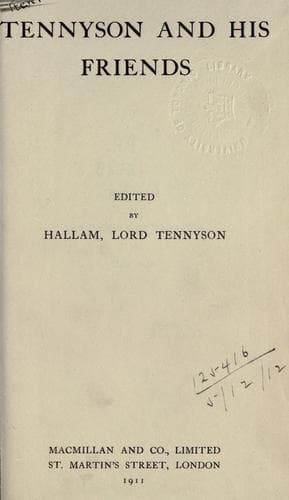
Tennyson, Alfred Tennyson, Baron, 1809-1892 -- Friends and associates
He became, when about fifteen years old, a member of the debating
society established among the elder boys, in which he took great
interest; and this served to confirm the bias of his intellect towards
the moral and political philosophy of modern times. It was probably,
however, of important utility in giving him that command of his own
language which he possessed, as the following Essays will show, in a
very superior degree, and in exercising those powers of argumentative
discussion, which now displayed themselves as eminently characteristic
of his mind. It was a necessary consequence that he declined still
more from the usual paths of study, and abated perhaps somewhat of his
regard for the writers of antiquity. It must not be understood,
nevertheless, as most of those who read these pages will be aware,
that he ever lost his sensibility to those ever-living effusions of
genius which the ancient languages preserve. He loved Aeschylus and
Sophocles (to Euripides he hardly did justice), Lucretius and Virgil;
if he did not seem so much drawn towards Homer as might at first be
expected, this may probably be accounted for by his increasing taste
for philosophical poetry.
In the early part of 1827, Arthur took a part in the Eton Miscellany,
a periodical publication, in which some of his friends in the debating
society were concerned. He wrote in this, besides a few papers in
prose, a little poem on a story connected with the Lake of Killarney.
It has not been thought by the Editor advisable, upon the whole, to
reprint these lines; though, in his opinion, they bear very striking
marks of superior powers. This was almost the first poetry that Arthur
had written, except the childish tragedies above mentioned. No one was
ever less inclined to the trick of versifying. Poetry with him was not
an amusement, but the natural and almost necessary language of genuine
emotion; and it was not till the discipline of serious reflection, and
the approach of manhood, gave a reality and intenseness to such
emotions, that he learned the capacities of his own genius. That he
was a poet by nature, these Remains will sufficiently prove; but
certainly he was far removed from being a versifier by nature; nor was
he probably able to perform, what he scarce ever attempted, to write
easily and elegantly on an ordinary subject. The lines on the story of
Pygmalion are so far an exception, that they arose out of a momentary
amusement of society; but he could not avoid, even in these, his own
grave tone of poetry.
Public-domain text, read in full here on John Shaqi.
Reviews
Reviews
No reviews yet
Be the first to share your thoughts on this work.
Elsewhere in the archive
Join the Discussion
Join the discussion
Sign in to leave a comment or review.
Sign InorCreate an account