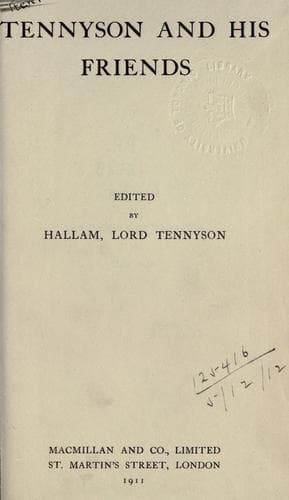
Tennyson, Alfred Tennyson, Baron, 1809-1892 -- Friends and associates
Upon leaving Eton in the summer of 1827, he accompanied his parents to
the Continent, and passed eight months in Italy. This introduction to
new scenes of nature and art, and to new sources of intellectual
delight, at the very period of transition from boyhood to youth,
sealed no doubt the peculiar character of his mind, and taught him,
too soon for his peace, to sound those depths of thought and feeling
from which, after this time, all that he wrote was derived. He had,
when he passed the Alps, only a moderate acquaintance with the Italian
language; but during his residence in the country he came to speak it
with perfect fluency, and with a pure Sienese pronunciation. In its
study he was much assisted by his friend and instructor, the Abbate
Pifferi, who encouraged him to his first attempts at versification.
The few sonnets, which are now printed, were, it is to be remembered,
written by a foreigner, hardly seventeen years old, and after a very
short stay in Italy. The Editor might not, probably, have suffered
them to appear even in this private manner, upon his own judgment. But
he knew that the greatest living writer of Italy, to whom they were
shown some time since at Milan, by the author's excellent friend, Mr.
Richard Milnes, has expressed himself in terms of high approbation.
The growing intimacy of Arthur with Italian poetry led him naturally
to that of Dante. No poet was so congenial to the character of his own
reflective mind; in none other could he so abundantly find that
disdain of flowery redundance, that perpetual preference of the
sensible to the ideal, that aspiration for somewhat better and less
fleeting than earthly things, to which his inmost soul responded. Like
all genuine worshippers of the great Florentine poet, he rated the
_Inferno_ below the two latter portions of the _Divina Commedia_;
there was nothing even to revolt his taste, but rather much to attract
it, in the scholastic theology and mystic visions of the _Paradiso_.
Petrarch he greatly admired, though with less idolatry than Dante; and
the sonnets here printed will show to all competent judges how fully
he had imbibed the spirit, without servile centonism, of the best
writers in that style of composition who flourished in the sixteenth
century.
Public-domain text, read in full here on John Shaqi.
Reviews
Reviews
No reviews yet
Be the first to share your thoughts on this work.
Elsewhere in the archive
Join the Discussion
Join the discussion
Sign in to leave a comment or review.
Sign InorCreate an account