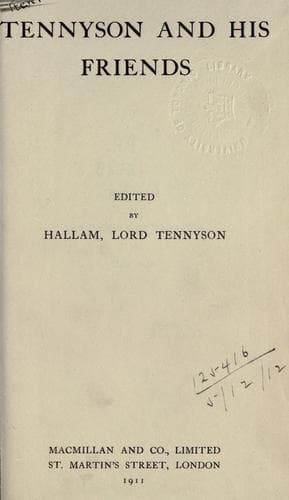
Tennyson, Alfred Tennyson, Baron, 1809-1892 -- Friends and associates
But poetry was not an absorbing passion at this time in his mind. His
eyes were fixed on the best pictures with silent intense delight. He
had a deep and just perception of what was beautiful in this art, at
least in its higher schools; for he did not pay much regard, or
perhaps quite do justice, to the masters of the seventeenth century.
To technical criticism he made no sort of pretension; painting was to
him but the visible language of emotion; and where it did not aim at
exciting it, or employed inadequate means, his admiration would be
withheld. Hence he highly prized the ancient paintings, both Italian
and German, of the age which preceded the full development of art. But
he was almost as enthusiastic an admirer of the Venetian, as of the
Tuscan and Roman schools; considering these masters as reaching the
same end by the different agencies of form and colour. This
predilection for the sensitive beauties of painting is somewhat
analogous to his fondness for harmony of verse, on which he laid more
stress than poets so thoughtful are apt to do. In one of the last days
of his life, he lingered long among the fine Venetian pictures of the
Imperial Gallery at Vienna.
He returned to England in June 1828; and, in the following October,
went down to reside at Cambridge; having been entered on the boards of
Trinity College before his departure to the Continent. He was the
pupil of the Rev. William Whewell. In some respects, as soon became
manifest, he was not formed to obtain great academical reputation. An
acquaintance with the learned languages, considerable at the school
where he was educated, but not improved, to say the least, by the
intermission of a year, during which his mind had been so occupied by
other pursuits, that he had thought little of antiquity even in Rome
itself, though abundantly sufficient for the gratification of taste
and the acquisition of knowledge, was sure to prove inadequate to the
searching scrutiny of modern examinations. He soon, therefore, saw
reason to renounce all competition of this kind; nor did he ever so
much as attempt any Greek or Latin composition during his stay at
Cambridge. In truth he was very indifferent to success of this kind;
and conscious as he must have been of a high reputation among his
contemporaries, he could not think that he stood in need of any
University distinctions. The Editor became by degrees almost equally
indifferent to what he perceived to be so uncongenial to Arthur's
mind. It was, however, to be regretted that he never paid the least
attention to mathematical studies. That he should not prosecute them
with the diligence usual at Cambridge, was of course to be expected;
yet his clearness and acumen would certainly have enabled him to
master the principles of geometrical reasoning; nor, in fact, did he
Public-domain text, read in full here on John Shaqi.
Reviews
Reviews
No reviews yet
Be the first to share your thoughts on this work.
Elsewhere in the archive
Join the Discussion
Join the discussion
Sign in to leave a comment or review.
Sign InorCreate an account