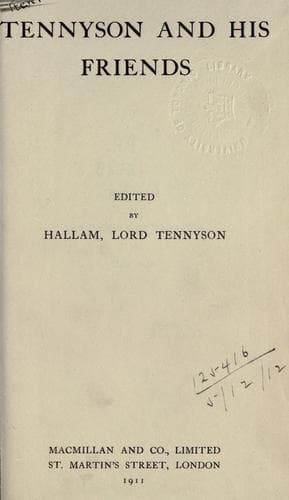
Tennyson, Alfred Tennyson, Baron, 1809-1892 -- Friends and associates
But another reason may be given for his deficiency in those
unremitting labours which the course of academical education, in the
present times, is supposed to exact from those who aspire to its
distinctions. In the first year of his residence at Cambridge,
symptoms of disordered health, especially in the circulatory system,
began to show themselves; and it is by no means improbable, that these
were indications of a tendency to derangement of the vital functions,
which became ultimately fatal. A too rapid determination of blood
towards the brain, with its concomitant uneasy sensations, rendered
him frequently incapable of mental fatigue. He had indeed once before,
at Florence, been affected by symptoms not unlike these. His
intensity of reflection and feeling also brought on occasionally a
considerable depression of spirits, which had been painfully observed
at times by those who watched him most, from the time of his leaving
Eton, and even before. It was not till after several months that he
regained a less morbid condition of mind and body. This same
irregularity of circulation returned in the next spring, but was of
less duration. During the third year of his Cambridge life, he
appeared in much better health.
In this year (1831) he obtained the first college prize for an English
declamation. The subject chosen by him was the conduct of the
Independent party during the civil war. This exercise was greatly
admired at the time, but was never printed. In consequence of this
success, it became incumbent on him, according to the custom of the
college, to deliver an oration in the chapel immediately before the
Christmas vacation of the same year. On this occasion he selected a
subject very congenial to his own turn of thought and favourite study,
the influence of Italian upon English literature. He had previously
gained another prize for an English essay on the philosophical
writings of Cicero. This essay is perhaps too excursive from the
prescribed subject; but his mind was so deeply imbued with the higher
philosophy, especially that of Plato, with which he was very
conversant, that he could not be expected to dwell much on the praises
of Cicero in that respect.
Public-domain text, read in full here on John Shaqi.
Reviews
Reviews
No reviews yet
Be the first to share your thoughts on this work.
Elsewhere in the archive
Join the Discussion
Join the discussion
Sign in to leave a comment or review.
Sign InorCreate an account