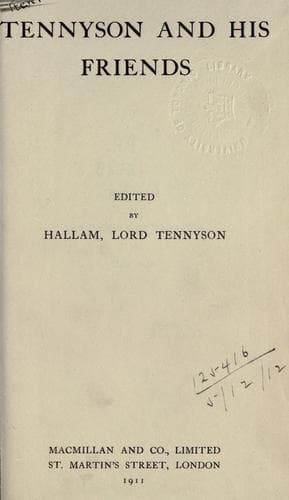
Tennyson, Alfred Tennyson, Baron, 1809-1892 -- Friends and associates
Though the bent of Arthur's mind by no means inclined him to strict
research into facts, he was full as much conversant with the great
features of ancient and modern history, as from the course of his
other studies and the habits of his life it was possible to expect. He
reckoned them, as great minds always do, the groundworks of moral and
political philosophy, and took no pains to acquire any knowledge of
this sort from which a principle could not be derived or illustrated.
To some parts of English history, and to that of the French
Revolution, he had paid considerable attention. He had not read nearly
so much of the Greek and Latin historians as of the philosophers and
poets. In the history of literary, and especially of philosophical and
religious opinions, he was deeply versed, as much so as it is possible
to apply that term at his age. The following pages exhibit proofs of
an acquaintance, not crude or superficial, with that important branch
of literature.
His political judgments were invariably prompted by his strong sense
of right and justice. These, in so young a person, were naturally
rather fluctuating, and subject to the correction of advancing
knowledge and experience. Ardent in the cause of those he deemed to be
oppressed, of which, in one instance, he was led to give a proof with
more of energy and enthusiasm than discretion, he was deeply attached
to the ancient institutions of his country.
He spoke French readily, though with less elegance than Italian, till
from disuse he lost much of his fluency in the latter. In his last
fatal tour in Germany, he was rapidly acquiring a readiness in the
language of that country. The whole range of French literature was
almost as familiar to him as that of England.
The society in which Arthur lived most intimately, at Eton and at the
University, was formed of young men, eminent for natural ability, and
for delight in what he sought above all things, the knowledge of
truth, and the perception of beauty. They who loved and admired him
living, and who now revere his sacred memory, as of one to whom, in
the fondness of regret, they admit of no rival, know best what he was
in the daily commerce of life; and his eulogy should, on every
account, better come from hearts which, if partial, have been rendered
so by the experience of friendship, not by the affection of nature.
Public-domain text, read in full here on John Shaqi.
Reviews
Reviews
No reviews yet
Be the first to share your thoughts on this work.
Elsewhere in the archive
Join the Discussion
Join the discussion
Sign in to leave a comment or review.
Sign InorCreate an account