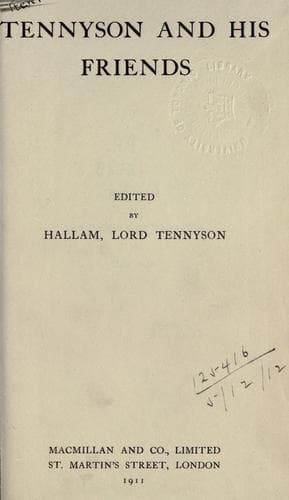
Tennyson, Alfred Tennyson, Baron, 1809-1892 -- Friends and associates
Arthur left Cambridge on taking his degree in January 1832. He resided
from that time with the Editor in London, having been entered on the
boards of the Inner Temple. It was greatly the desire of the Editor
that he should engage himself in the study of the law; not merely with
professional views, but as a useful discipline for a mind too much
occupied with habits of thought, which, ennobling and important as
they were, could not but separate him from the everyday business of
life, and might, by their excess, in his susceptible temperament, be
productive of considerable mischief. He had, during the previous long
vacation, read with the Editor the _Institutes_ of Justinian, and the
two works of Heineccius which illustrate them; and he now went through
Blackstone's _Commentaries_, with as much of other law-books as, in
the Editor's judgment, was required for a similar purpose. It was
satisfactory at that time to perceive that, far from showing any of
that distaste to legal studies which might have been anticipated from
some parts of his intellectual character, he entered upon them not
only with great acuteness, but considerable interest. In the month of
October 1832, he began to see the practical application of legal
knowledge in the office of an eminent conveyancer, Mr. Walters of
Lincoln's Inn Fields, with whom he continued till his departure from
England in the following summer.
It was not, however, to be expected, or even desired by any one who
knew how to value him, that he should at once abandon those habits of
study which had fertilized and invigorated his mind. But he now, from
some change or other in his course of thinking, ceased in a great
measure to write poetry, and expressed to more than one friend an
intention to give it up. The instances after his leaving Cambridge
were few. The dramatic scene between Raffaelle and Fiammetta was
written in 1832; and about the same time he had a design to translate
the _Vita Nuova_ of his favourite Dante; a work which he justly
prized, as the development of that immense genius, in a kind of
autobiography, which best prepares us for a real insight into the
_Divine Comedy_. He rendered accordingly into verse most of the
sonnets which the _Vita Nuova_ contains; but the Editor does not
believe that he made any progress in the prose translation. These
sonnets appearing rather too literal, and consequently harsh, it has
not been thought worth while to print.
Public-domain text, read in full here on John Shaqi.
Reviews
Reviews
No reviews yet
Be the first to share your thoughts on this work.
Elsewhere in the archive
Join the Discussion
Join the discussion
Sign in to leave a comment or review.
Sign InorCreate an account