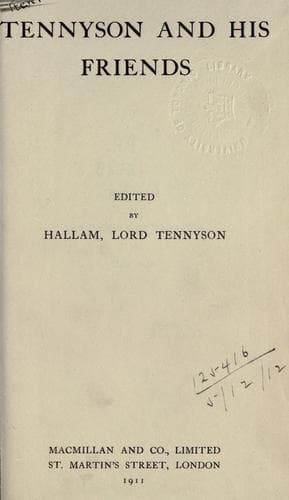
Tennyson, Alfred Tennyson, Baron, 1809-1892 -- Friends and associates
In 1854 he published his first volume of verse, _Days and Hours_. The book
was, on the whole, well received. Charles Kingsley (whose early and
discriminating recognition of the merits of George Meredith places him
high among the critics of his day) wrote: "The poems are the work of a
finished scholar, of a man who knows all schools, who has profited more or
less by all, and who often can express himself, while revelling in
luxurious fancies, with a grace and terseness which Pope himself might
have envied." There was, however, a good deal of adverse criticism, and it
was probably mainly owing to his irritation at many of the strictures
(often futile enough) which were passed upon him at this time that he kept
silence for the next thirty-six years. At any rate, he was always ready to
the end of his life for a growl or a thunder at the critics.
In 1857 Frederick Tennyson left Florence and after spending some time in
Pisa and Genoa finally settled in Jersey, where he made his home for
nearly forty years. During all this period he maintained a regular and
detailed correspondence with Mrs. Brotherton, the wife of his friend
Augustus Brotherton, the artist, with whom he had begun to exchange
letters while still at Florence. His life was now a very quiet one, for,
except for an occasional visit to England, he never left home. His
children with their families visited him from time to time. His brother
Charles came with his wife to see him in 1867, as did the Brownings on
their way to Italy, and Alfred also paid him visits, the last of which was
in 1892. On the whole, however, his days, for one who had been so
passionately fond of travel and of a life of colour, warmth, and
excitement, were singularly peaceful. But he retained to the last his
astonishing vitality. His health remained tolerably good in spite of the
nervous irritability and reactions of melancholy which were inseparable
from the extraordinary energy and vivacity of his temperament. "Poor
Savile Morton used to stare at me with wonder," he writes. "'I cannot
conceive,' he said, 'how a man with such a stomach can be subject to
hypochondria.'" In 1867, at the age of sixty, he batted for an hour to his
nephew Lionel's bowling, hoping thereby to be able "to revive the cricket
habit," and his mind continued extraordinarily active; not a movement in
world politics or thought escaped him; he read voraciously and continued
to write verse in a rather desultory fashion. His appetite for beauty,
too, remained as keen as ever and even developed. "The longer I live," he
wrote in 1885, "the more delicate become my perceptions of beautiful
nature." And that appetite found ample food in the scenery of the bowery
island, the whole ambit of which, with its curling tree-tops and distant
lawny spaces dappled with sunshine and surrounded, as it seemed, by the
whole immensity of the globe, could be seen from a point near his house.
Public-domain text, read in full here on John Shaqi.
Reviews
Reviews
No reviews yet
Be the first to share your thoughts on this work.
Join the Discussion
Join the discussion
Sign in to leave a comment or review.
Sign InorCreate an account