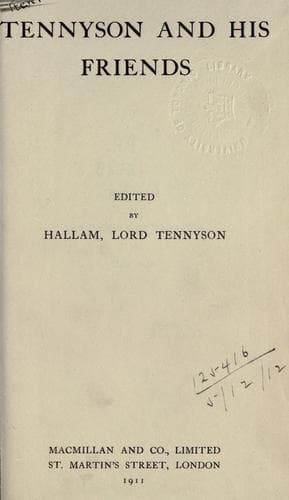
Tennyson, Alfred Tennyson, Baron, 1809-1892 -- Friends and associates
For two or three things every lover of Tennyson must thank FitzGerald. He
it was who, about 1838, soon after their friendship began, got his friend,
Samuel Laurence, to paint the earliest portrait of the Poet, "the only one
of the old days and still the best of all to my thinking," as he wrote in
1871. He, too, preserved and gave to Tennyson the drawing by Thackeray of
the "Lord of Burleigh." When the Poet was rather dilatory in calling at
Spedding's house to claim this portrait, FitzGerald wrote: "Tell him I
don't think Browning would have served me so, and I mean to prefer his
poems for the future." He also rescued from the flames some of the pages
of the famous "Butcher's Book," the tall, ledger-like MS. volume, in which
many of the early poems he so much loved were written, and gave them to
the Library of Trinity College. About this he wrote:
MARKETHILL, WOODBRIDGE,
_December 4th, 1864_.
DEAR ALFRED--Now I should be almost ready to be "yours ever, etc." if
I didn't remember to ask you if you have any objection to my giving
two or three of the leaves of your old "Butcher's Book" (do you
remember?) to the Library at Trinity College? An admirer of your's
there told me they would be glad of some such thing--It was in 1842,
when you were printing the two good old volumes:--in Spedding's
rooms--and the "Butcher's Book," after its margins serving for
pipe-lights, went leaf by leaf into the fire: and I told you I would
keep two or three leaves of it as a remembrance. So I took a bit of my
old favourite "Audley Court": and a bit of another, I forget which:
for I can't lay my hands on them just now. But when I do, I shall give
them to Trinity College unless you are strongly opposed. I dare say,
however, you would give them the whole MS. of one of your later
poems: which probably they would value more.
Tennyson appreciated "Old Fitz's" fine qualities as a critic, but he
recognized their limitations, and in particular his "crotchets" and
prejudices. He was himself, as is now generally recognized, a consummate
critic, and withal a most kindly and catholic one. In my first
conversation with him he said that he used to think Goethe a good critic.
"He always discovered all the good he could in a man." To his own
contemporaries, especially towards Browning, for example, his attitude was
very different, as FitzGerald acknowledged, from FitzGerald's own. I did
not like, I remember, to ask him what he thought of Browning, but his son
encouraged me to do so. "You ask him," he said. "He'll tell you at once."
At last I did so. "A true genius, but wanting in art," he said. And on
another occasion he spoke rather more in detail to the same purpose.
Public-domain text, read in full here on John Shaqi.
Reviews
Reviews
No reviews yet
Be the first to share your thoughts on this work.
Elsewhere in the archive
Join the Discussion
Join the discussion
Sign in to leave a comment or review.
Sign InorCreate an account