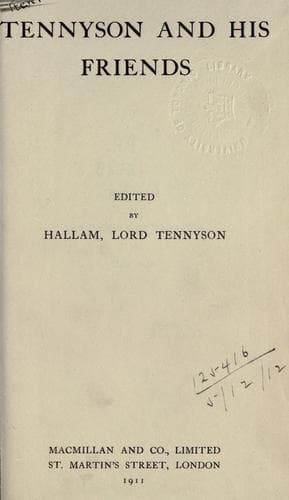
Tennyson, Alfred Tennyson, Baron, 1809-1892 -- Friends and associates
DEAR MRS. TENNYSON--Talking of ships again, I liked much _The Captain_
in the People's Alfred. Was the last stanza (which I like also) an
afterthought?--I think a really _sublime_ thing is the end of
Kingsley's "Westward Ho!"--(which I never could read through)--The
Chase of the Ships: the Hero's being struck blind at the moment of
revenge: then his being taken to _see_ his rival and crew at the
bottom of the sea. Kingsley is a distressing writer to me: but I must
think this (the inspiration of it) of a piece with Homer and the
Gods--which you won't at all.
He liked, too, "Gareth and Lynette," which again he thought more natural
and direct than some of the earlier Idylls. He liked, as might have been
expected, the "Ballads and other Poems." But what is most significant,
perhaps, among his likes and dislikes, is his love for "Audley Court,"
"one of my old favourites," he calls it. Why did FitzGerald like "Audley
Court"? It is not one of the poems which are generally best known and
most admired. Indeed, while it is in many ways beautiful and contains some
splendid things, such as the sonorous line
The pillar'd dusk of sounding sycamores,
it is just one of those poems which the severe critic of Tennyson picks
out for fault-finding and even for ridicule. It has what such critics call
the over-elaborate, the "drawing-room" manner. Like Milton's picture of
Eve's _déjeuner_, though with more humour and appropriateness, it employs
the grand and sumptuous style to describe trifles, such as the venison
pasty:
Where quail and pigeon, lark and leveret lay,
Like fossils of the rock, with golden yolks
Imbedded and injellied.
But on a closer consideration it will be seen that it has just what "Old
Fitz" himself loved--the easy realism, the contentment with the things of
this world; above all, that flavour of
After-dinner talk
Across the walnuts and the wine
which he also found and loved in that other favourite, "The Miller's
Daughter," the harmless gossip about old friends
who was dead,
Who married, who was like to be, and how
The races went, and who would rent the hall.
This suited "Old Fitz's" temper absolutely. The humorous _pococurantism_,
for cynicism it hardly is, of the quatrains put into the mouth of the
Poet's friend, each ending "but let me live my life," breathes the very
spirit of his own indolent, kindly Epicureanism, and indeed the poem might
almost be taken as a record of a dialogue between the two friends in their
early days.
He loved, too, the "Lord of Burleigh," "The Vision of Sin," and "The Lady
of Shalott." The delicious idealism of these youthful pieces did not
displease him. They had for him a "champagne flavour." They were part of
his own youth. For a brief hour of that fast-fleeting day, the wine of
life had sparkled in his own glass, but then too soon turned flat and
flavourless.
Public-domain text, read in full here on John Shaqi.
Reviews
Reviews
No reviews yet
Be the first to share your thoughts on this work.
Elsewhere in the archive
Join the Discussion
Join the discussion
Sign in to leave a comment or review.
Sign InorCreate an account