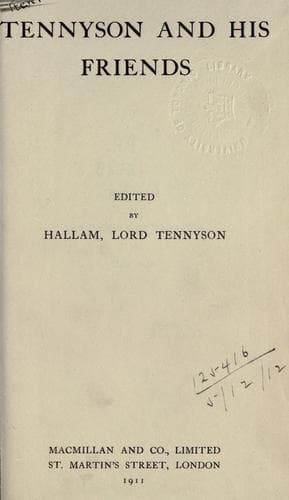
Tennyson, Alfred Tennyson, Baron, 1809-1892 -- Friends and associates
With Thackeray himself he always maintained the same cordial relations as
he did with Tennyson. But his literary attitude shifted and varied in the
same way. Here, again, he preferred the early work which he had seen in
process of creation. In later years, when they met him at Woodbridge, he
said to "Alfred" and his son, "I hardly dare take down Thackeray's early
books, because they are so great. It's like waking the Thunder." He wrote
of Thackeray in 1849: "He is just the same. All the world 'admires _Vanity
Fair_,' and the author is courted by Dukes and Duchesses and wits of both
sexes. I like _Pendennis much_, and Alfred said he thought it was quite
delicious: it seemed to him so _mature_ he said." But a little later he
took alarm at the Dukes and Duchesses, and wrote to Frederick Tennyson: "I
am come to London, but I do not go to Operas or Plays, and have scarce
time (and it must be said, scarce inclination) to hunt up many friends--I
get shyer and shyer even of those I knew. Thackeray is in such a great
world that I am afraid of him; he gets tired of me and we are content to
regard each other at a distance. You, Alfred, Spedding, and Allen, are the
only men I ever care to see again.... As you know, I admire your poems,
the only poems by a living writer I do admire, except Alfred's."
He told Hallam Tennyson that he greatly admired the charming scene in
"Philip" where the young lady unexpectedly discovered her lover (Philip)
on the box of the diligence, and quieted the screaming children inside by
saying, "Hush! _he's_ there."
In particular, he was very severe on anything he called "cockney,"
speaking, that is, the language of the town, not of the country; in other
words, dealing with nature and human nature at second-hand. To this his
letters again and again return. Of "fine writing," as he called it, even
when it occurred in his own early work, he was unsparingly critical. Thus
of _Euphranor_ he wrote to Mrs. Kemble: "The Dialogue is a pretty thing in
some respects but disfigured by some confounded _smart_ writing in parts."
He thought this fault in particular, so he says in a letter to Frederick
Tennyson, "the loose screw in American literature," and deplored its
presence in Lowell, a writer whom otherwise he liked. "I honestly admire
his work in the main," he says, "and I think he is altogether the best
critic we have, something of what Ste. Beuve is in French." He thought
that Tennyson came to suffer from these defects in his later days, and
that the artist overpowered the man.
Public-domain text, read in full here on John Shaqi.
Reviews
Reviews
No reviews yet
Be the first to share your thoughts on this work.
Elsewhere in the archive
Join the Discussion
Join the discussion
Sign in to leave a comment or review.
Sign InorCreate an account