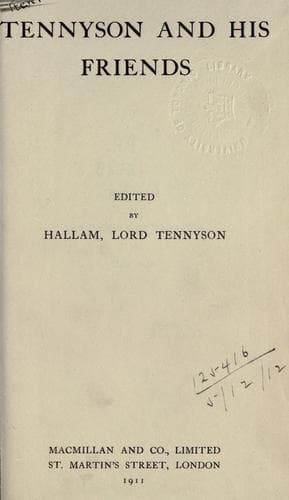
Tennyson, Alfred Tennyson, Baron, 1809-1892 -- Friends and associates
The latest of Tennyson's poems, of course, he did not live to see. He did
not see, for instance, "Crossing the Bar." What would he have thought of
it? Another old friend of Tennyson, also a fastidious critic, the Duke of
Argyll, in an unpublished letter of February 1, 1892, writing of this and
of the lines on the "Death of the Duke of Clarence," says: "Magnificent,
is all I can say of your lines in the _Nineteenth_. The two last things of
yours that I have seen, this and the 'Bar,' are both perfect in their
several ways, and such as no other man could have written. The 'Bar' is
the type of what I define Poetry to be, great thought in true imagery and
unusual expression. All the three are needed for the type thing. Much fine
poetry is to me only eloquence, which is quite another thing." With the
last sentence FitzGerald would certainly have agreed, for it is what in
other words he was himself constantly saying. But he seemed to require
something more than great thoughts and true images and choice diction.
Poignant and revealing touches, what he called in Crabbe "shrewd hits";
feeling, as well as, if not more than, thought--this was what he asked
for. All Browning's genius seemed to him _emphase_, cleverness, curiosity,
"cockneyism."
"The Dramatic Idylls," he writes to Frederick Tennyson, "seemed to me
'Ingoldsby.' It seems to me as if the Beautiful being already appropriated
by former men of genius, those who are not inspired, can only try for a
Place among them by recourse to the Quaint, Grotesque, and Ugly in all the
Arts,--what I call the Gargoyle style." And again: "I always said he must
be a cockney, and now I find he is Camberwell-born--
It once was the Pastoral cockney,
It now is the cockney Profound."
The establishment of the Browning Society tried him specially. "Imagine a
man abetting all this," he writes. Tennyson had, through life, a high
opinion of FitzGerald's powers of criticism. They had often in their youth
discussed the classics of all time and all times together, and also, with
the poetic freedom of young men, their seniors, Shelley, and Byron, and
Wordsworth. It was FitzGerald who invented for the last the name by which
he went in their circle, of the "Daddy." They had fought for the ownership
of the Wordsworthian line, the "weakest blank verse in the language":
A Mr. Wilkinson, a clergyman.
It really was FitzGerald's description, given in conversation, of the
gentleman who was going to marry his sister. When he died in 1862
FitzGerald, writing to Tennyson, reminded him of the line.
"This letter," he writes, "ought to be on a black-edged paper in a
black-edged cover: for I have just lost a brother-in-law--one of the
best of Men. If you ask, 'Who?' I reply, in what you once called the
weakest line ever enunciated:
A Mister Wilkinson, a Clergyman.
You can't remember this: in Old Charlotte Street, ages ago!"
In the valedictory verses Tennyson makes allusion to this critical habit:
Public-domain text, read in full here on John Shaqi.
Reviews
Reviews
No reviews yet
Be the first to share your thoughts on this work.
Elsewhere in the archive
Join the Discussion
Join the discussion
Sign in to leave a comment or review.
Sign InorCreate an account