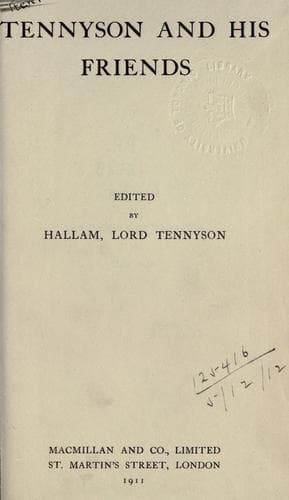
Tennyson, Alfred Tennyson, Baron, 1809-1892 -- Friends and associates
The complement to "Old Fitz" was Carlyle. He was the friend of both
FitzGerald and Tennyson. Gruff, grumbling, self-centred, satirical, at
times even rude and rough, as he was, both of them seemed to have got not
so much on his blind, as on his kind side from the first, and always to
have remained there. Carlyle's descriptions of Tennyson as a young man in
the early "forties" and of the pleasure he had in his company are well
known. "He seemed to take a fancy to me," Tennyson said himself one day
while we talked about him at Farringford. They foregathered a good deal
at this period, sat and smoked silently, walked and talked together, both
by day and night. FitzGerald told Hallam Tennyson, years after, during the
visit to Woodbridge, that Carlyle was much concerned at this period about
his father's poverty, and said to him, "Alfred must have a pension." The
story of the way in which he spurred on "Dicky" Milnes to secure the
pension is now classical. What his special effect, if he had any, on
Tennyson was, it might be difficult to estimate or analyse.
The younger generation to-day does not remember the period of Carlyle's
immense influence. It lasted just into the youth of my contemporaries and
myself, or perhaps a little longer, and then began to wane and die away.
He certainly was a "radio-active" force in the days and with the men of
Tennyson's youth,--Maurice, and Sterling, and "Dicky" Milnes, as he was a
little later with Ruskin and Kingsley. FitzGerald, with his detachment and
his fearless sincerity, estimated him as fairly as any one. "Do you see
Carlyle's _Latter-Day Pamphlets_?" he wrote. "They make the world laugh,
and his friends rather sorry for him. But that is because people will
still look for practical measures from him. One must be content with him
as a great satirist who can make us feel when we are wrong, though he
cannot set us right. There is a bottom of truth in Carlyle's wildest
rhapsodies."
He wrote to Frederick Tennyson in 1850: "When I spoke of the 'Latter-Day
Prophet' I conclude you have read or heard of Carlyle's Pamphlets. People
are tired of them and of him; he only foams, snaps, and howls and no
progress people say. This is about true, and yet there is vital good in
all he has written." Again, in 1854, he says, "Carlyle I did not go to
see, for I have really nothing to tell him, and I am tired of hearing him
growl, tho' I admire him as much as ever." "I wonder if he ever thinks how
much sound and fury he has vented," he writes on another occasion.
But the posthumous publication of Carlyle's Letters, as he wrote about a
fortnight before his own death, "raised him in FitzGerald's esteem"; and
his last effort was to go to Chelsea to see his statue, and the old house
hard by which he had not seen for five-and-twenty years, to find it, alas,
"deserted, neglected, and 'To let!'"
Public-domain text, read in full here on John Shaqi.
Reviews
Reviews
No reviews yet
Be the first to share your thoughts on this work.
Elsewhere in the archive
Join the Discussion
Join the discussion
Sign in to leave a comment or review.
Sign InorCreate an account