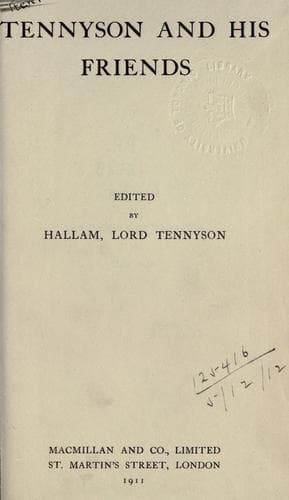
Tennyson, Alfred Tennyson, Baron, 1809-1892 -- Friends and associates
Carlyle was indeed much what "Old Fitz" describes. He was a powerful
solvent of his age. He destroyed many shams, "Hebrew rags," "old clothes,"
as he called them. Both by his own example and his fiery energy he
inculcated the "Gospel of Work." He was not a modern realist, but a man
who dealt in realities, who perceived that virtue and beauty and faith are
as real as vice and ugliness and unfaith, nay, perhaps more real; but that
certainly neither are shams, neither God nor the Devil, though of shams,
of false gods and false devils, there are many. His appreciation of poetry
was, as is well known, but scant and intermittent. He used to banter
Tennyson and call him "a Life-Guardsman spoiled by making poetry," but he
became converted even to his poems, though, as he said, this was
surprising to himself. He "felt the pulse of a real man's heart" in the
1842 volumes. "Ulysses" was a special favourite. He quoted again and again
the lines:
It may be that the gulfs will wash us down;
It may be we shall touch the Happy Isles,
And see the great Achilles whom we knew.
"These lines do not make me weep," he said, "but there is in me what would
fill whole Lachrymatories as I read." He, fortunately, also "took a fancy"
to Mrs. Tennyson when he met her as a bride at Tent Lodge, Coniston,
partly because, in answer to one of his wild grumbles, she said, "That is
not sane, Mr. Carlyle." An unpublished letter from Carlyle of the date
October 1850, describes an admirer of Tennyson's poems, an ill-starred but
brave man, a skilful physician, a friend of Dr. John Carlyle at
Leamington, who, after losing the greater part of his face by _caries_ of
the bone, had at last been cured, though awfully disfigured. "He fled to
Keswick," writes Carlyle, "and there he now resides, not idle still, nor
forsaken of friends, or hope, or domestic joy--a monument of human
courtesy, and really a worthy and rather interesting man. Such is your
admirer and mine. Heaven be good to him and us."
FitzGerald, in a letter to Frederick Tennyson, quotes with approval a
criticism of Lowell's that Carlyle "was a poet in all but rhythm"; and it
would not be difficult to find "parallel passages" between Tennyson and
Carlyle, between _Sartor Resartus_ and "In Memoriam." The _Life of
Sterling_, too, should be read by any student anxious to "reconstitute the
atmosphere" in which that poem grew up, and which, to a certain extent, it
still breathes. But "parallel passages" are misleading. Suffice it to say
that both went through the storm and stress of a doubting age, both took
their stand on the solid rock of God and of real, healthy human
nature,--both emerged in the "Eternal Yea."
Froude, in his history of Carlyle's Life in London, has a most interesting
autobiographic passage about Carlyle's position and influence in 1843, the
time of the publication of _Past and Present_, which brings this out with
special force. He says:
Public-domain text, read in full here on John Shaqi.
Reviews
Reviews
No reviews yet
Be the first to share your thoughts on this work.
Elsewhere in the archive
Join the Discussion
Join the discussion
Sign in to leave a comment or review.
Sign InorCreate an account