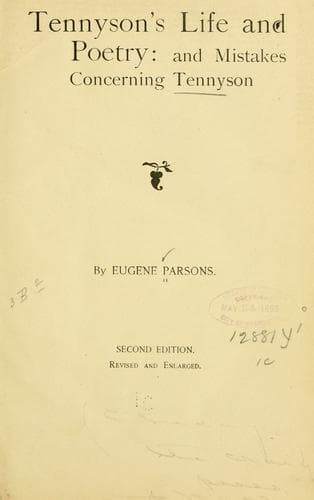
Tennyson's Life and Poetry: And Mistakes Concerning TennysonParsons, Eugene
General
Tennyson's Life and Poetry: And Mistakes Concerning Tennyson
Parsons, Eugene
Tennyson, Alfred Tennyson, Baron, 1809-1892
From his twelfth to his sixteenth year, Alfred was apparently idle much of
the time, yet he was unconsciously preparing for his life-work. He was
gathering material and storing up impressions which were afterwards
utilized. It was with him a formative period. The hours he spent strolling
in lanes and woods were not wasted. The quiet, meditative boy lived in a
realm of the imagination, and his thoughts and fancies took shape in crude
poems.
This period of day-dreaming was followed by one of marked intellectual
activity. The thin volume--_Poems by Two Brothers_, printed in 1826,
contained the pieces written by Alfred when he was only sixteen or
seventeen. It shows that these were busy years. The Tennyson youths not
only scribbled a great deal of verse--they ranged far and wide in the
fields of ancient and modern literature. Their father had a good library,
and they appreciated its treasures. In the footnotes of their first book
were many curious bits of information, and quotations from the classics.
The Tennyson children were fortunate in having cultured parents. They were
favored in another respect. Dr. Tennyson was comfortably well off for a
clergyman. His means--which he shrewdly husbanded--enabled the family to
spend the summers at Mablethorpe on the Lincolnshire coast. Thus Alfred's
passion for the sea was early developed. For some time it was the rector's
custom to occupy a dwelling in Louth during the school year. In this way
the seclusion and monotony of Somersby life were broken. The young
Tennysons saw considerable of the world. They were often welcomed in the
home of their grandmother, Mrs. Fytche, in Westgate Place, and
occasionally visited the stately mansion at Bayons. Especially Charles and
Alfred were at times the guests of their great-uncle Samuel Turner, vicar
of Grasby and curate of Caistor, who afterwards left his property and
parish livings to his favorite, Charles Tennyson Turner. Such were the
experiences of the Laureate's youth and childhood, which inevitably
influenced his whole life and entered into his poetry. He illustrates the
truth that a poet is largely what his environment makes him.
Byron exercised a magical spell over him in his teens, and this influence
is apparent in his boyish rhymes which are tinged with Byronic melancholy.
Afterwards Keats gained the ascendency. As a colorist, Tennyson owes much
to this gorgeous word-painter, whom he has equaled, if not surpassed, in
his own field.
Alfred, in his boyhood, gave unmistakable indications of genius. During
his university course at Cambridge, he was generally looked upon as a
superior mortal, of whom great things were expected by his teachers and
fellow-collegians. Dr. Whewell, his tutor, treated him with unusual
respect.
Public-domain text, read in full here on John Shaqi.
Reviews
Reviews
No reviews yet
Be the first to share your thoughts on this work.
Join the Discussion
Join the discussion
Sign in to leave a comment or review.
Sign InorCreate an account