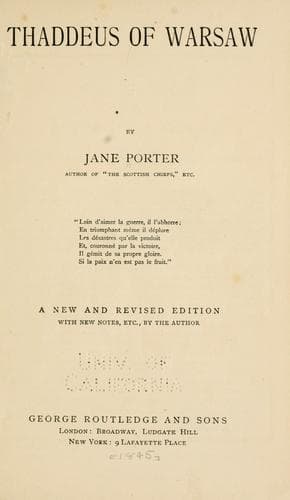
Poland -- History -- Stanislaus II Augustus, 1764-1795 -- Fiction
"Thaddeus," said she, "lay down that sword; I wish to speak with
you." Thaddeus looked gayly up. "My dear Thaddeus!" cried his mother,
and tears started to her eyes. The blush of enthusiasm faded from his
face; he threw the sabre from him, and drew near the countess.
"Why, my dear mother, do you distress yourself? When I am in battle,
shall I not have my grandfather near me, and be as much under the
protection of God as at this moment?"
"Yes, my child," answered she, "God will protect you. He is the
protector of the orphan, and you are fatherless." The countess
paused--"Here, my son," said she, giving him a sealed packet, "take
this; it will reveal to you the history of your birth and the name of
your father. It is necessary that you should know a painful fact,
which has hitherto been concealed from you by the wish and noble
judgment of your grandfather." Thaddeus received it, and stood silent
with surprise. "Read it, my love," continued she, "but go to your own
apartments; here you may be interrupted."
Bewildered by the manner of the countess, Thaddeus, without
answering, instantly obeyed. Shutting himself within his study, he
impatiently opened the papers, and soon found his whole attention
absorbed in the following recital.
"TO MY DEAR SON, THADDEUS CONSTANTINE SOBIESKI.
"You are now, my Thaddeus, at the early age of nineteen, going to
engage the enemies of your country. Ere I resign my greatest comfort
to the casualties of war; ere I part with you, perhaps forever, I
would inform you who your father really was--that father whose
existence you have hardly known and whose name you have never heard.
You believe yourself an orphan, your mother a widow; but, alas! I
have now to tell you that you were made fatherless by the perfidy of
man, not by the dispensation of Heaven.
"Twenty-three years ago, I accompanied my father in a tour through
Germany and Italy. Grief for the death of my mother had impaired his
health, and the physicians ordered him to reside in a warmer climate;
accordingly we fixed ourselves near the Arno. During several visits
to Florence, my father met in that city with a young Englishman of
the name of Sackville. These frequent meetings opened into intimacy,
and he was invited to our villa.
"Mr. Sackville was not only the most interesting man I had ever seen,
but the most accomplished, and his heart seemed the seat of every
graceful feeling. He was the first man for whose society I felt a
lively preference. I used to smile at this strange delight, or
sometimes weep; for the emotions which agitated me were undefinable,
but they were enchanting, and unheedingly I gave them indulgence. The
hours which we passed together in the interchange of reciprocal
sentiments, the kind beaming of his looks, the thousand sighs that he
breathed, the half-uttered sentences, all conspired to rob me of
myself.
Public-domain text, read in full here on John Shaqi.
Reviews
Reviews
No reviews yet
Be the first to share your thoughts on this work.
Join the Discussion
Join the discussion
Sign in to leave a comment or review.
Sign InorCreate an account