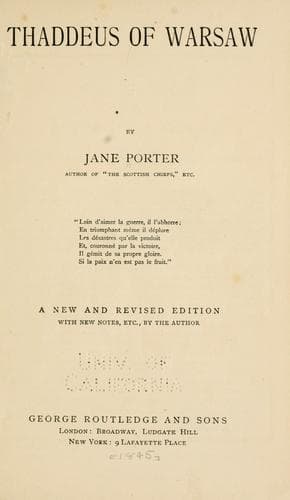
Poland -- History -- Stanislaus II Augustus, 1764-1795 -- Fiction
Of this argument Lady Sara knew little. She never reflected on the
true nature of religion, though she sometimes went to church,
repeated the prayers, without being conscious of their spirit; and
when the coughing, sneezing, and blowing of noses which commonly
accompany the text subsided, she generally called up the remembrance
of the last ball, or an anticipation of the next assembly, to amuse
herself until the prosing business was over. From church she drove to
the Park, where, bowling round the ring, or sauntering in the
gardens, she soon forgot that there existed in the universe a Power
of higher consequence to please than her own vanity--and the
admiration of the spectators.
Lady Sara would have shuddered at hearing any one declare himself a
deist, much more an atheist; but for any influence which her nominal
belief held over her desires, she might as well have been either. She
never committed an action deserving the name of premeditated injury,
nor went far out of her way to do her best friend a service,--not
because she wanted inclination, but she ceased to remember both the
petitioner and his petition before he had been five minutes from her
sight. She had read as much as most fine ladies have read: a few
histories, a few volumes of essays, a few novels, and now and then a
little poetry comprised the whole range of her studies; these, with
morning calls and evening assemblies, occupied her whole day. Such
had been the routine of her life until she met the once "young star"
of Poland, Thaddeus Sobieski, in an unknown exile, an almost nameless
guest, at Lady Tinemouth's, which event caused a total revolution in
her mind and conduct.
The strength of Lady Sara's understanding might have credited a
better education; but her passions bearing an equal power with this
mental vigor, and having taken a wrong direction, she neither
acknowledged the will nor the capability to give the empire to her
reason. When love really entered her heart, its first conquest was
over her universal vanity; she surrendered all her admirers, in the
hope of securing the admiration of Thaddeus; its second victory
mastered her discretion; she revealed her unhappy affection to Lady
Tinemouth, and more than hinted it to himself. What had she else to
lose? She believed her honor to be safer than her life. Her
_honor_ was the term. She had no conception, or, at best, a
faint one, that a breach of the marriage vow could be an outrage on
the laws of Heaven. The word sin had been gradually ignored by the
oligarchy of fashion, from the hour in which Charles the Second and
his profligate court trod down piety with hypocrisy; and in this day
the new philosophy has accomplished its total outlawry, denouncing it
as a rebel to decency and the freedom of man.
Public-domain text, read in full here on John Shaqi.
Reviews
Reviews
No reviews yet
Be the first to share your thoughts on this work.
Elsewhere in the archive
Join the Discussion
Join the discussion
Sign in to leave a comment or review.
Sign InorCreate an account