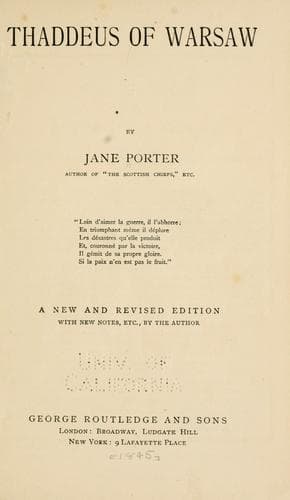
Poland -- History -- Stanislaus II Augustus, 1764-1795 -- Fiction
"It was then that our friend Butzou (who at that period was a private
soldier in my service) stood between his majesty and the rebels,
parrying many a stroke aimed at the king; but at last, a thrust from
a bayonet into his gallant defender's breast cast him weltering in
his blood upon me. By this time all the persons who had formed the
escort were either wounded or dispersed, and George Butzou, our
friend's only brother, was slain. So dropped one by one the
protectors of our trampled bodies and of our outraged monarch. Secure
then of their prey, one of the assassins opened the carriage door,
and with shocking imprecations seizing the king, discharged his
pistol so near his majesty's face, that he felt the heat of the
flash. A second villain cut him on the forehead with a sabre, whilst
the third, who was on horseback, laying hold of the king's collar,
dragged him along the ground through the suburbs of the city.
"During the latter part of this murderous scene, some of our
affrighted people, who had fled, returned with a detachment, and
seeing Butzou and me apparently lifeless, carried us to the royal
palace, where all was commotion and distraction. But the foot-guards
followed the track which the conspirators had taken. In one of the
streets they found the king's hat dyed in blood, and his pelisse
also. This confirmed their apprehensions of his death; and they came
back filling all Warsaw with dismay.
"The assassins, meanwhile, got clear of the town. Finding, however,
that the king, by loss of blood, was not likely to exist much longer
by dragging him towards their employer, and that delay might even
lose them his dead body, they mounted him, and redoubled their speed.
When they came to the moat, they compelled him to leap his horse
across it. In the attempt the horse fell and broke its leg. They then
ordered his majesty, fainting as he was, to mount another and spur it
over. The conspirators had no sooner passed the ditch, and saw their
king fall insensible on the neck of his horse, than they tore from
his breast the ribbon of the black eagle, and its diamond cross.
Lukawski was so foolishly sure of his prisoner, dead or alive, that
he quitted his charge, and repaired with these spoils to Pulaski,
meaning to show them as proofs of his success. Many of the other
plunderers, concluding that they could not do better than follow
their leader's example, fled also, tired of their work, leaving only
seven of the party, with Kosinski at their head, to remain over the
unfortunate Stanislaus, who shortly after recovered from his swoon.
Public-domain text, read in full here on John Shaqi.
Reviews
Reviews
No reviews yet
Be the first to share your thoughts on this work.
Join the Discussion
Join the discussion
Sign in to leave a comment or review.
Sign InorCreate an account