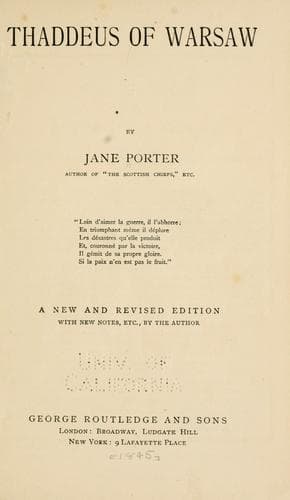
Poland -- History -- Stanislaus II Augustus, 1764-1795 -- Fiction
"Regardless of my own condition, I instantly got into a carriage, and
followed by a detachment of horse, arrived at the mill. I met
Kosinski at the door, keeping guard with his sword drawn. As he knew
my person, he admitted me directly. The king had fallen into a sleep,
and lay in one corner of the hovel on the ground, covered with the
miller's cloak. To see the most virtuous monarch in the world thus
abused by a party of ungrateful subjects pierced me to the heart.
Kneeling down by his side, I took hold of his hand, and in a paroxysm
of tears, which I am not ashamed to confess, I exclaimed, 'I thank
thee, Almighty God, that I again see our true-hearted sovereign still
alive!' It is not easy to say how these words struck the simple
family. They dropped on their knees before the king, whom my voice
had awakened, and besought his pardon, for their recent opposition to
give him entrance. The good Stanislaus soon quieted their fears, and
graciously thanking them for their kindness, told the miller to come
to the palace the next day, when he would show him his gratitude in a
better way than by promises.
"The officers of the detachment then assisted his majesty and myself
into the carriage, and accompanied by Kosinski, we reached Warsaw
about six in the morning."
"Yes," interrupted Butzou; "I remember my tumultuous joy when the
news was brought to me in my bed that my brave brother had not died
in vain for his sovereign; it almost deprived me of my senses; and
besides, his majesty visited me, his poor soldier, in my chamber.
Does not your excellency recollect how he was brought into my room on
a chair, between two men? and how he thanked me, and shook hands with
me, and told me my brother should never be forgotten in Poland? It
made me weep like a child."
"And he never can!" cried Thaddeus, hardly recovering from the deep
attention with which he had listened to this recital. [Footnote: The
king had his brave defender buried with military honors, and caused a
noble monument to be raised over him, with an inscription, of which
the following is a translation:--
"Here lieth the respected remains of George Butzou, who, on the 3d of
September, 1771, opposing his own breast to shield his sovereign from
the weapons of national parricides, was pierced with a mortal wound,
and triumphantly expired. Stanislaus the king, lamenting the death of
so faithful a subject, erects this monument as a tribute to him and
an example of heroic duty to others."] "But what became of Kosinski?
For doubtless the king kept his word."
Public-domain text, read in full here on John Shaqi.
Reviews
Reviews
No reviews yet
Be the first to share your thoughts on this work.
Join the Discussion
Join the discussion
Sign in to leave a comment or review.
Sign InorCreate an account