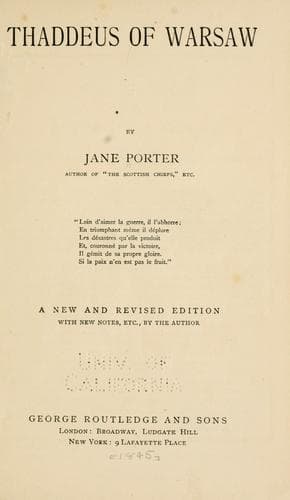
Poland -- History -- Stanislaus II Augustus, 1764-1795 -- Fiction
But it was, as I have already said, some years after the partition of
Poland that I wrote, and gave for publication, my historical romance
on that catastrophe. It was finished amid a circle of friends well
calculated to fan the flame which had inspired its commencement some
of the leading heroes of the British army just returned from the
victorious fields of Alexandria and St. Jean d'Acre; and, seated in
my brother's little study, with the war-dyed coat in which the
veteran Abercrombie breathed his last grateful sigh, while, like
Wolfe, he gazed on the boasted invincible standard of the enemy,
brought to him by a British soldier,--with this trophy of our own
native valor on one side of me, and on the other the bullet-torn vest
of another English commander of as many battles,--but who, having
survived to enjoy his fame, I do not name here,--I put my last stroke
to the first campaigns of Thaddeus Sobieski.
When the work was finished, some of the persons near me urged its
being published. But I argued, in opposition to the wish, its
different construction to all other novels or romances which had gone
before it, from Richardson's time-honored domestic novels to the
penetrating feeling in similar scenes by the pen of Henry Mackenzie;
and again, Charlotte Smith's more recent, elegant, but very
sentimental love stories. But the most formidable of all were the
wildly interesting romances of Anne Radcliffe, whose magical wonders
and mysteries were then the ruling style of the day. I urged, how
could any one expect that the admiring readers of such works could
consider my simply-told biographical legend of Poland anything better
than a dull union between real history and a matter-of-fact
imagination?
Arguments were found to answer all this; and being excited by the
feelings which had dictated my little work, and encouraged by the
corresponding characters with whom I daily associated, I ventured the
essay. However, I had not read the sage romances of our older times
without turning to some account the lessons they taught to
adventurous personages of either sex; showing that even the boldest
knight never made a new sally without consecrating his shield with
some impress of acknowledged reverence. In like manner, when I
entered the field with my modern romance of Thaddeus of Warsaw, I
inscribed the first page with the name of the hero of Acre. That
dedication will be found through all its successive editions, still
in front of the title-page; and immediately following it is a second
inscription, added, in after years, to the memory of the magnanimous
patriot and exemplary man, Thaddeus Kosciusko, who had first filled
me with ambition to write the tale, and who died in Switzerland, A.
D. 1817, fuller of glory than of years. Yet, if life be measured by
its vicissitudes and its virtues, we may justly say, "he was gathered
in his ripeness."
Public-domain text, read in full here on John Shaqi.
Reviews
Reviews
No reviews yet
Be the first to share your thoughts on this work.
Join the Discussion
Join the discussion
Sign in to leave a comment or review.
Sign InorCreate an account