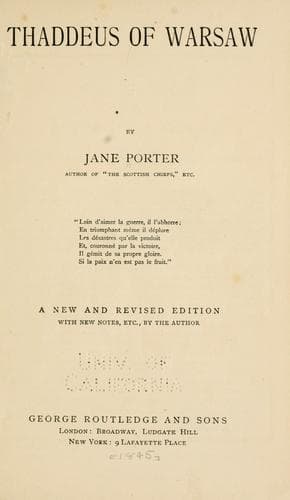
Poland -- History -- Stanislaus II Augustus, 1764-1795 -- Fiction
"The palace of Villanow, which is castellated, now burst upon my
view. It rears its embattled head from the summit of a hill that
gradually slopes down towards the Vistula, in full view to the south
of the plain of Vola, a spot long famous for the election of the
kings of Poland. [Footnote: It was from this very assumption by the
nation, on the extinction of the male line of the monarchs of the
house of Jaghellon, that all their subsequent political calamities
may be dated. The last two sovereigns of this race were most justly
styled good and great kings---father and son--Sigismund I. and II.
But on the death of the last, about the middle of the sixteenth
century, certain nobles of the nation, intoxicated with their wealth
and privileges, run wild for dictation in all things; and as the
foundation for such rule, they determined to make the succession of
their future kings entirely dependent on the free vote of public
suffrage; and the plain of Vola was made the terrible arena. So it
may be called; for, from the time of the first monarch so elected,
Henry of Valois, a stranger to the country, and brother to the
execrable Charles IX. of France, bribery or violence have been the
usual keys to the throne of Poland. For the doors of the country
being once opened by the misguided people themselves to the influence
of ambition, partiality, and passion, and shut against the old tenure
of a settled succession, foreign powers were always ready to step in,
with the gold or the sword; and Poland necessarily became a vassal
adjunct to whatever neighboring country furnished the new sovereign.
Thus it was, with a few exceptions (as is still case of the glorious
John Sobieski), until the election of Stanislaus Augustus, who,
though nominated by the power of the Empress of Russia, yet being,
like Sobieski, a native prince of the nation, determined to govern
the people of Poland in the spirit of his and their most glorious
ancestors; and true to the vow, treading in the steps of the last of
the Jaghellons, he gave to Poland the constitution of 1791, which,
with the re-enaction of many wise laws, again made the throne
hereditary. Hence the devoted struggles of every arm in the country
in loyal defence of such a recovered existence.] On the north of the
building, the earth is cut into natural ramparts, which rise in high
succession until they reach the foundations of the palace, where they
terminate in a noble terrace. These ramparts, covered with grass,
overlook the stone outworks, and spread down to the bottom of the
hill, which being clothed with fine trees and luxuriant underwood,
forms such a rich and verdant base to the fortress as I have not
language to describe: were I privileged to be poetical, I would say
it reminds me of the God of war sleeping amid roses in the bower of
love. Here the eye may wander over the gifts of bounteous Nature,
arraying hill and dale in all the united treasures of spring and
autumn.
Public-domain text, read in full here on John Shaqi.
Reviews
Reviews
No reviews yet
Be the first to share your thoughts on this work.
Join the Discussion
Join the discussion
Sign in to leave a comment or review.
Sign InorCreate an account