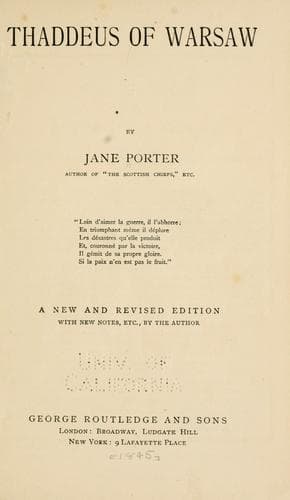
Poland -- History -- Stanislaus II Augustus, 1764-1795 -- Fiction
"'Then I pity them,' returned Thaddeus. 'Men who cannot ardently
feel, cannot taste supreme happiness. My grandfather educated me at
the feet of patriotism; and when I forget his precepts and example,
may my guardian angel forget me!'
"'Happy, glorious Thaddeus!' cried I, grasping his hand; 'how I envy
you your destiny! to live as you do, in the lap of honor, virtue and
glory the aim and end of your existence!'
"The animated countenance of my friend changed at these words, and
laying his hand on my arm, he said, 'Do not envy me my destiny.
Pembroke, you are the son of a free and loyal country, at peace with
itself; insatiate power has not dared to invade its rights. Your
king, in happy security, reigns in the confidence of his people,
whilst our anointed Stanislaus is baited and insulted by oppression
from without and ingratitude within. Do not envy me; I would rather
live in obscurity all my days than have the means which calamity may
produce of acquiring celebrity over the ruins of Poland. O! my
friend, the wreath that crowns the head of conquest is thick and
bright; but that which binds the olive of peace on the bleeding
wounds of my country will be the dearest to me.'
"Such sentiments, my clear madam, have opened new lights upon my poor
mistaken faculties. I never considered the subject so maturely as my
friend has done; victory and glory were with me synonymous words. I
had not learned, until frequent conversations with the young, ardent,
and pious Sobieski taught me, how to discriminate between animal
courage and true valor--between the defender of his country and the
ravager of other states. In short, I see in Thaddeus Sobieski all
that my fancy hath ever pictured of the heroic character. Whilst I
contemplate the sublimity of his sentiments and the tenderness of his
soul, I cannot help thinking how few would believe that so many
admirable qualities could belong to one mind, and that mind remain
unacquainted with the throes of ambition or the throbs of self-love."
Pembroke judged rightly of his friend; for if ever the real
disinterested _amor patriæ_ glowed in the breast of a man, it
animated the heart of the young Sobieski. At the termination of the
foregoing sentence in the letter to his mother, Pembroke was
interrupted by the entrance of a servant, who presented him a packet
which had that moment arrived from St. Petersburg. He took it, and
putting his writing materials into a desk, read the following epistle
from his governor:
"TO PEMBROKE SOMERSET, ESQ.
"My dear sir,
"I have this day received your letter, enclosing one for Lady
Somerset. You must pardon me that I have detained it, and will
continue to do so until I am favored with your answer to this, for
which I shall most anxiously wait.
Public-domain text, read in full here on John Shaqi.
Reviews
Reviews
No reviews yet
Be the first to share your thoughts on this work.
Join the Discussion
Join the discussion
Sign in to leave a comment or review.
Sign InorCreate an account