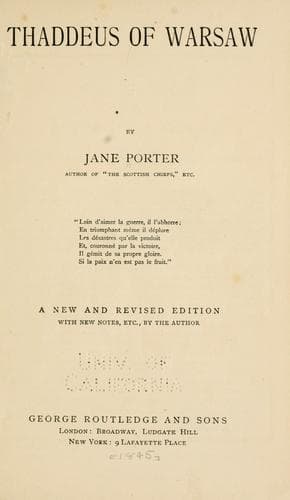
Poland -- History -- Stanislaus II Augustus, 1764-1795 -- Fiction
"Was I to blame, Mr. Somerset? Would not any man of sensibility and
honor have comprehended such advances from a woman of her rank and
reputation? I could not be mistaken; her looks and words needed no
explanation which my judgment could not pronounce. Though I am aware
that I do not possess that _lumen purpureum juveniæ_ which
attracts very young, uneducated women, yet I am not much turned of
fifty; and from the baroness's singular behavior, I had every reason
to expect handsomer treatment than she has been pleased to dispense
to me since my return to this capital.
"But to proceed regularly--(I must beg your pardon for the warmth
which has hurried me to this digression): you know, sir, that from
the hour in which I had the honor of taking leave of your noble
family in England, I strove to impress upon your rather volatile mind
a just and accurate conception of the people amongst whom I was to
conduct you. When I brought you into this extensive empire, I left no
means unexerted to heighten your respect not only for its amiable
sovereign, but for all powers in amity with her. It is the
characteristic of genius to be zealous. I was so, in favor of the
pretensions of the great Catherine to that miserable country in which
you now are, and to which she deigned to offer her protection. To
this zeal, and my unfortunate though honorable devotion to the wishes
of the baroness, I am constrained to attribute my present dilemma.
"When Poland had the insolence to rebel against its illustrious
mistress, you remember that all the rational world was highly
incensed. The Baroness Surowkoff declared herself frequently, and
with vehemence she appealed to me. My veracity and my principles were
called forth, and I confessed that I thought every friend to the
Tzaritza ought to take up arms against that ungrateful people. The
Count Brinicki was then appointed to command the Russian forces
preparing to join the formidable allies; and her ladyship, very
unexpectedly on my part, answered me by approving what I said, and
added that of course I meant to follow her cousin into Poland, for
that even she, as a woman, was so earnest in the cause, she would
accompany him to the frontiers, and there await the result.
"What could I do? How could I withstand the expectations of a lady of
her quality, and one who I believed loved me? However, for some time
I did oppose my wish to oblige her; I urged my cloth, and the
impossibility of accounting for such a line of conduct to the father
of my pupil? The baroness ridiculed all these arguments as mere
excuses, and ended with saying, 'Do as you please, Mr. Loftus. I have
been deceived in your character; the friend of the Baroness Surowkoff
must be consistent; he must be as willing to fight for the cause he
espouses as to speak for it: in this case, the sword must follow the
oration, else we shall see Poland in the hands of a rabble.'
Public-domain text, read in full here on John Shaqi.
Reviews
Reviews
No reviews yet
Be the first to share your thoughts on this work.
Join the Discussion
Join the discussion
Sign in to leave a comment or review.
Sign InorCreate an account