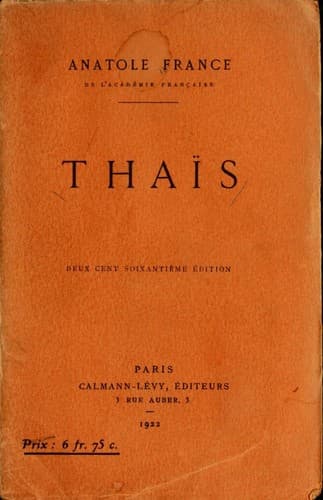
Christian women saints -- Fiction; Christianity, Conversion to -- Fiction; Courtesans -- Fiction; Egypt -- Fiction; Hermits -- Fiction
“Hear the truth, Dorion, and receive the light.”
But he saw then that all heads were turned towards him, and everybody
was making signs for him to be quiet. Dead silence prevailed in the
theatre, broken at last by the strains of heroic music.
The play began. The soldiers left their tents, and were preparing to
depart, when a prodigy occurred--a cloud covered the summit of the
funeral pile. Then the cloud rolled away, and the ghost of Achilles
appeared, clad in golden armour. Extending his arms towards the
warriors, he seemed to say to them, “What! do you depart, children of
Danaos? do you return to the land I shall never behold again, and leave
my tomb without any offerings?” Already the principal Greek chieftains
pressed to the foot of the pile. Acamas, the son of Theseus, old Nestor,
Agamemnon, bearing a sceptre and with a fillet on his brow, gazed at the
prodigy. Pyrrhus, the young son of Achilles, was prostrate in the dust.
Ulysses, recognisable by the cap which covered his curly hair, showed
by his gestures that he acquiesced in the demand of the hero’s shade. He
argued with Agamemnon, and their words might be easily guessed--
“Achilles,” said the King of Ithaca, “is worthy to be honoured by us,
for he died gloriously for Hellas. He demands that the daughter of
Priam, the virgin Polyxena, should be immolated on his tomb. Greeks!
appease the manes of the hero, and let the son of Peleus rejoice in
Hades.”
But the king of kings replied--
“Spare the Trojan virgins we have torn from the altars. Sufficient
misfortunes have already fallen on the illustrious race of Priam.”
He spoke thus because he shared the couch of the sister of Polyxena, and
the wise Ulysses reproached him for preferring the couch of Cassandra to
the lance of Achilles.
The Greeks showed they shared the opinion of Ulysses, by loudly clashing
their weapons. The death of Polyxena was resolved on, and the appeased
shade of Achilles vanished. The music--sometimes wild and sometimes
plaintive--followed the thoughts of the personages in the drama. The
spectators burst into applause.
Paphnutius, who applied divine truth to everything murmured--
“This fable shows how cruel the worshippers of false gods were.”
“All religions breed crimes,” replied the Epicurean. “Happily, a
Greek, who was divinely wise, has freed men from foolish terrors of the
unknown--”
Just at that moment, Hecuba, her white hair dishevelled, her robe
tattered, came out of the tent in which she was kept captive. A long
sigh went up from the audience, when her woeful figure appeared. Hecuba
had been warned by a prophetic dream, and lamented her daughter’s fate
and her own. Ulysses approached her, and asked her to give up Polyxena.
The old mother tore her hair, dug her nails into her cheeks, and kissed
the hands of the cruel chieftain, who, with unpitying calmness, seemed
to say--
Public-domain text, read in full here on John Shaqi.
Reviews
Reviews
No reviews yet
Be the first to share your thoughts on this work.
Join the Discussion
Join the discussion
Sign in to leave a comment or review.
Sign InorCreate an account