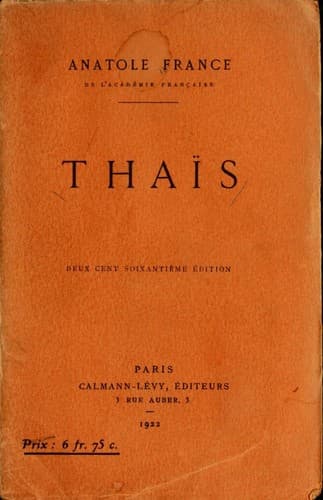
Christian women saints -- Fiction; Christianity, Conversion to -- Fiction; Courtesans -- Fiction; Egypt -- Fiction; Hermits -- Fiction
THAIS. Go away! I wish to be loved with body and soul. All these
philosophers are old goats.
The lamps died out one by one. The pale rays of dawn, which entered
between the openings of the hangings, shone on the livid faces and
swollen eyes of the guests. Aristobulus was sleeping soundly by the side
of Chereas, and, in his dreams, devoting all his grooms to the ravens.
Zenothemis pressed in his arms the yielding Philina; Dorion poured on
the naked bosom of Drosea drops of wine, which rolled like rubies on the
white breast, which was shaking with laughter, and the philosopher
tried to catch these drops with his lips, as they rolled on the slippery
flesh. Eucrites rose, and placing his arm on the shoulder of Nicias, led
him to the end of the hall.
“Friend,” he said, smiling, “if you can still think at all--of what are
you thinking?”
“I think that the love of women is like a garden of Adonis.”
“What do you mean by that?”
“Do you not know, Eucrites, that women make little gardens on the
terraces, in which they plant boughs in clay pots in honour of the lover
of Venus? These boughs flourish a little time, and then fade.”
“What does that signify, Nicias? That it is foolish to attach importance
to that which fades?”
“If beauty is but a shadow, desire is but a lightning flash. What
madness it is, then, to desire beauty! Is it not rational, on the
contrary, that that which passes should go with that which does not
endure, and that the lightning should devour the gliding shadow?”
“Nicias, you seem to me like a child playing at knuckle-bones. Take my
advice--be free! By liberty only can you become a man.”
“How can a man be free, Eucrites, when he has a body?”
“You shall see presently, my son. Presently you will say, ‘Eucrites was
free.’”
The old man spoke, leaning against a porphyry pillar, his face lighted
by the first rays of dawn. Hermodorus and Marcus had approached, and
stood before him by the side of Nicias; and all four, regardless of the
laughter and cries of the drinkers, conversed on things divine. Eucrites
expresses himself so wisely and eloquently, that Marcus said--
“You are worthy to know the true God.”
Eucrites replied--
“The true God is in the heart of the wise man.”
Then they spoke of death.
“I wish,” said Eucrites, “that it may find me occupied in correcting
my faults, and attentive to all my duties. In the face of death I will
raise my pure hands to heaven, and I will say to the gods, ‘Your
images, gods, that you have placed in the temple of my soul, I have not
profaned; I have hung there my thoughts, as well as garlands, fillets,
and wreaths. I have lived according to your providence. I have lived
enough.’”
Thus speaking, he raised his arms to heaven, and he remained thoughtful
a moment. Then he continued, with extreme joy--
“Separate thyself from life, Eucrites, like the ripe olive which falls;
returning thanks to the tree which bore thee, and blessing the earth,
thy nurse.”
Public-domain text, read in full here on John Shaqi.
Reviews
Reviews
No reviews yet
Be the first to share your thoughts on this work.
Join the Discussion
Join the discussion
Sign in to leave a comment or review.
Sign InorCreate an account