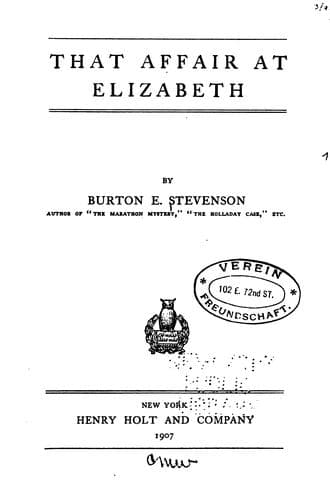
Detective and mystery stories; Fiction; Love stories
There was a signature scrawled in one corner, and I bent closer to
decipher it.
"It was painted by a cousin of mine," said Miss Kingdon indifferently.
And suddenly the scrawl became intelligible.
"'Ruth Endicott,'" I read, with a quick glow of interest.
"What do you know of her?" she demanded, looking at me sharply.
"Nothing," I answered, as indifferently as I could. "Only, I should be
interested to know how she developed. She seems to have had great
talent."
"That was the last picture she ever painted," said Miss Kingdon shortly;
then her eyes flamed suddenly and her face darkened, as she stepped
close to the portrait and stared at it. "She was beautiful--beautiful!"
she murmured hoarsely, and I knew that Ruth Endicott's last painting had
been a portrait of herself.
And yet it was scarcely a portrait, either, for the features were barely
indicated. But, gazing at it, one saw a woman there--a woman real and
vital--and knew instinctively that she was beautiful. It was what I
suppose would be called an impressionistic picture, but it differed from
most impressionistic pictures in showing imagination in the artist
instead of demanding it from the observer.
But why should that pictured face seem so familiar? Not in lineament,
but in poise and expression it recalled some one vividly. There was no
doubting the resemblance, but grope in my memory as I might, I could not
place it.
"When you are quite ready," said Miss Kingdon, in a voice quivering with
impatience, "I shall be glad to show you out."
I turned to find her glaring at me almost like a beast at bay. With an
imperious gesture, which checked on my lips any questions I would have
asked, she led the way out into the hall.
"You are at liberty to search the house," she said coldly, intercepting
the glance I shot about me, "if you doubt my statement that Miss
Lawrence is no longer here."
The thought flashed through my mind that I would welcome a chance to
take a look into the cellar, and inspect the fruit which it had taken
hours to arrange, but I did not dare suggest it.
"No," I protested; "I believe you," and in another moment I was in the
street.
Godfrey was awaiting me.
"Well?" he asked.
"Not there," I said.
"But she was there?"
"Yes; it was there she took refuge--you were right about that; but she
left late last night. I don't know how or where. Miss Kingdon refused to
tell me."
He pondered this an instant with half-closed eyes.
"I don't think she can slip through our fingers," he said, at last.
"Every one about here knows her."
"If she took the train," I suggested, "the agent may remember."
"Yes," he agreed. "And by the way," he added suddenly, "it _was_ a
letter which caused all this trouble."
"A letter?"
Public-domain text, read in full here on John Shaqi.
Reviews
Reviews
No reviews yet
Be the first to share your thoughts on this work.
Join the Discussion
Join the discussion
Sign in to leave a comment or review.
Sign InorCreate an account