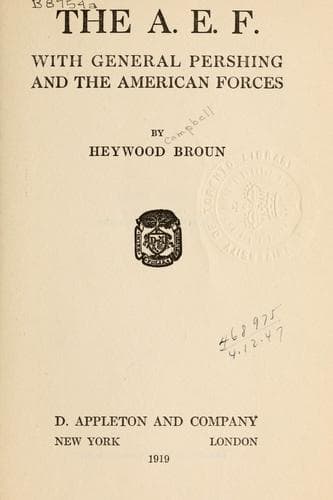
The A. E. F.: With General Pershing and the American ForcesBroun, Heywood
History
The A. E. F.: With General Pershing and the American Forces
Broun, Heywood
United States. Army. American Expeditionary Forces; World War, 1914-1918 -- Personal narratives
The gun had earned a rest now and we went down and looked at it. The
gunners had chalked a name on the carriage and we found that this
seventy-five which fired the first shot against the Germans was called
Heinie. We wanted to know the name of the man who fired the first shot.
Our consciences were troubling us about that. This was our first day up
with the guns in the American sector and the men had been in two days.
There were drawbacks in writing the war correspondence from a distance
as we had been compelled to do up to this time. We'd heard, of course,
that the first gun had been fired and that made it imperative that the
story should be "reconstructed," as the modern newspaperman says when
he's writing about something which he didn't see. Of course, everybody
back home would want to know who fired the first shot. Censorship
prevented the use of the name, but we couldn't blame the censors for
that, because when we wrote the stories we didn't know his name or
anything about him. With just one dissenting vote the correspondents
decided that the man who fired the first shot must have been a
red-headed Irishman. And so it was cabled. Now we wanted to know whether
he was.
The lieutenant told us the name, but that didn't settle the question. It
was a more or less non-committal name and the officer volunteered to
find out for us. He led the party over to the mouth of another dugout
and called down: "Sergeant ----, there's some newspapermen here and they
want to know whether you're Irish."
Immediately there was a scrambling noise down in the dugout and up came
the gunner on the run. "I am not," he said.
"Haven't you got an Irish father or mother or aren't any of your people
Irish?" asked one of the correspondents hopefully. He was committed to
the red-headed story and he was not prepared to give up yet. "Not one of
'em," said the sergeant, "I haven't got a drop of Irish blood in me. I
come from South Bend, Indiana."
The party left the gunner rather disconsolately. That is, all but the
hopeful correspondent. "He's Irish, all right," he said. We turned on
the optimist.
"Didn't you hear him say he wasn't Irish?" we shouted.
"Oh, that's all right," answered the optimist, "you didn't expect he was
going to admit it. They never do."
"Say," inquired another reporter, "did anybody notice what was the color
of the sergeant's hair?"
I had, but I said nothing. There had been disillusion enough for one
day. It was black with a little gray around the temples.
The lieutenant took us to his dugout and we tried to get some copy out
of him. A man from an evening newspaper spoiled our chances right away.
"I suppose," he said, "that you made a little speech to the men before
they fired that first shot?"
The little lieutenant was professional in an instant. He felt a sudden
fear that his manner or his youth had led us to picture him as a
romantic figure.
"What would I make a speech for?" he inquired coldly.
Public-domain text, read in full here on John Shaqi.
Reviews
Reviews
No reviews yet
Be the first to share your thoughts on this work.
Elsewhere in the archive
Join the Discussion
Join the discussion
Sign in to leave a comment or review.
Sign InorCreate an account