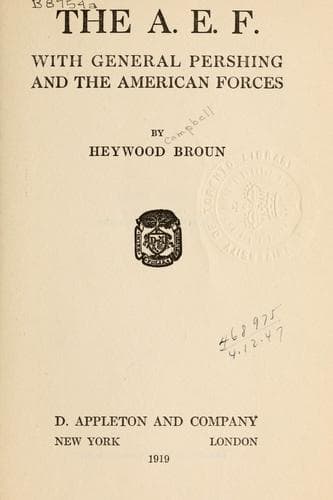
The A. E. F.: With General Pershing and the American ForcesBroun, Heywood
History
The A. E. F.: With General Pershing and the American Forces
Broun, Heywood
United States. Army. American Expeditionary Forces; World War, 1914-1918 -- Personal narratives
"Well," said the reporter, "I should think you'd want to say something.
You were going to fire the first shot of the war, and more than that,
you were going to fire the first shot in anger which the American army
has ever fired in Europe. Of course, I didn't mean a speech exactly, but
you must have said something."
"No," answered the officer, "I just gave 'em the range and then I said
'ready to fire' and then, 'fire.' It was just like this afternoon. We
made it perfectly regular."
"In the army a thing like that's just part of the day's work," the
lieutenant added, with an attempted assumption of great sophistication
in regard to war matters, as if this was at least his twentieth
campaign.
And yet I think that if we had heard our little quarterback give his
order at six twenty-seven on that misty morning there would have been
something in his voice when he said "fire" which would have betrayed him
to us. I think it must have been a little sharper, a little faster and a
little louder for this first shot than it will be when he calls "fire"
for the thousand-and-tenth round.
The guns had decided to call it a day by this time and so we headed for
the trenches. We had to travel across a big bare stretch of country
which was wind-swept and rain-soaked on this particular afternoon. Every
now and then somebody fell into a shell hole, for the meadow was well
slashed up, although there didn't seem to be anything much to shoot at.
On the whole, the sector chosen for the first Americans in the trenches
might well be called a quiet front. There was shelling back and forth
each day, but many places were immune. Some villages just back of the
French lines had not been fired at for almost a year, although they were
within easy range of field pieces, and the French in return didn't fire
at villages in the German lines. This was by tacit agreement. Both sides
had held the lines in this part of the country lightly and both sides
were content to sit tight and not stir up trouble.
Things livened up after the Americans came in because the Germans soon
found out that new troops were opposing them and they wanted to identify
the units. Some of the increasing liveliness was also due to the fact
that American gunners were anxious to get practice and fired much more
than the French had done. Indeed, an American officer earned a rebuke
from his superiors because he fired into a German village which had been
hitherto immune. This was a mistake, for the Germans immediately
retaliated by shelling a French village and the civilian population was
forced to move out. For more than a year they had lived close to the
battle lines in comparative safety. On the night the American troops
moved in to the trenches a baby was born in a village less than a mile
from one of our battalion headquarters. Major General Sibert became her
godfather and the child was christened Unis in honor of Les Etats Unis.
Public-domain text, read in full here on John Shaqi.
Reviews
Reviews
No reviews yet
Be the first to share your thoughts on this work.
Elsewhere in the archive
Join the Discussion
Join the discussion
Sign in to leave a comment or review.
Sign InorCreate an account