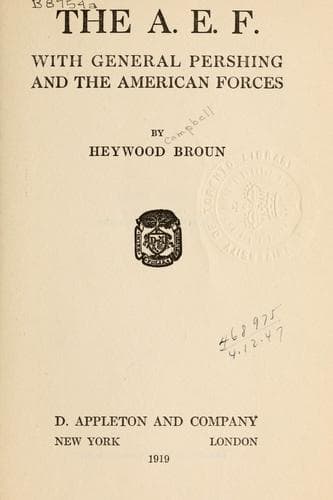
The A. E. F.: With General Pershing and the American ForcesBroun, Heywood
History
The A. E. F.: With General Pershing and the American Forces
Broun, Heywood
United States. Army. American Expeditionary Forces; World War, 1914-1918 -- Personal narratives
We went to the hospital in the little town and were allowed to look at
the first German prisoner. He was a pretty sick boy when we saw him. He
gave his age when examined as nineteen, but he looked younger and not
very dangerous, for he was just coming out of the ether. The American
doctors were giving him the best of care. He had a room to himself and
his own nurse. The doughboys had captured him close to the American
wire. There had been great rivalry as to which company would get the
first prisoner, but he came almost unsought. The patrol was back to its
own wire when the soldiers heard the noise of somebody moving about to
the left. He was making no effort to walk quietly. As he came over a
little hillock his outline could be seen for a second and one of the
Americans called out to him to halt. He turned and started to run, but a
doughboy fired and hit him in the leg and another soldier's bullet came
through his back. The patrol carried the prisoner to the trench. He
seemed much more dazed by surprise than by the pain of his wounds.
"You're not French," he said several times as the curious Americans
gathered about him in a close, dim circle illuminated by pocket flash
lamps. The prisoner next guessed that they were English and when the
soldiers told him that they were Americans he said that he and his
comrades did not know that Americans were in the line opposite them.
Somebody gave him a cigarette and he grew more chipper in spite of his
wounds. He began to talk, saying: "Ich bin ein esel."
There were several Americans who had enough German for that and they
asked him why. The prisoner explained that he had been assigned to
deliver letters to the soldiers. Some of the letters were for men in a
distant trench which slanted toward the French line, and so to save time
he had taken a short cut through No Man's Land. It was a dark night but
he thought he knew the way. He kept bearing to the left. Now, he said,
he knew he should have turned to the right. He said it would be a lesson
to him. The next morning we heard that the German had died and would be
buried with full military honors.
There was another patient whom we were interested in seeing. Lieutenant
Devere H. Harden was the first American officer wounded in the war. His
wound was not a very bad one and the doctors allowed us to crowd about
his bed and ask questions. In spite of the British saying, "you never
hear a shell that hits you," Harden said he both saw and heard his
particular shell. He thought it would have scored a direct hit on his
head if he had not fallen flat. As it was the projectile exploded almost
fifty feet away from him and his wound was caused by a fragment which
flew back and lodged behind his knee. He did not know that he had been
hit, but sought shelter in a dugout. Just as he got to the door he felt
a pain in his knee and fell over. He noticed then that his leg was
bleeding a little. A French officer ran over to him and said: "You are
a very lucky man."
Public-domain text, read in full here on John Shaqi.
Reviews
Reviews
No reviews yet
Be the first to share your thoughts on this work.
Elsewhere in the archive
Join the Discussion
Join the discussion
Sign in to leave a comment or review.
Sign InorCreate an account