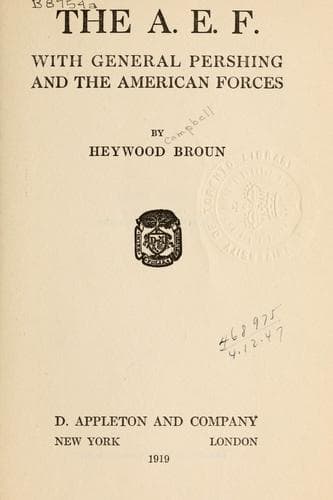
The A. E. F.: With General Pershing and the American ForcesBroun, Heywood
History
The A. E. F.: With General Pershing and the American Forces
Broun, Heywood
United States. Army. American Expeditionary Forces; World War, 1914-1918 -- Personal narratives
"We don't get anything much but slum," he said, when I asked him, "How's
the food?" That did not sound appetizing until I found out that slum was
a stew made of beef and potatoes and carrots and lots of onions. We ate
some and it was very good, but perhaps it does pall a little after the
third or fourth day. It forms the main staple of army diet in the
trenches, for it is not possible to give the men in the line any great
variety of food. The most tragic story in connection with food which we
heard concerned a company which was just beginning dinner when a gas
alarm was sounded. The men had been carefully trained to drop everything
and adjust their masks when this alarm was sounded. So down went their
mess tins, spilling slum on the trench floor as the masks were quickly
fastened. Five minutes later word came that the gas alarm was a mistake.
Before we left we saw a patrol start out. The doughboys took to
patrolling eagerly and officers who asked for volunteers were always
swamped with requests from men who wanted to go. One lieutenant was
surprised to have a large fat cook come to him to say that he would not
be happy unless allowed to make a trip across No Man's Land to the
German wire. When the officer asked him why he was so anxious to go, he
said: "Well, you see, I promised to get a German helmet and an overcoat
for a girl for Christmas and I haven't got much time left."
It was dark when we left the trenches and started cross country. The
German guns had begun to fire a little. They were spasmodically
shelling a clump of woods half a mile away and seemed indifferent to
correspondents. But by this time the weather was actively hostile. The
rain had changed to snow and the wind had risen to a gale. Every shell
hole had become a trap to catch the unwary and wet him to the waist.
Little brooks were carrying on like rivers and amateur lakes were
everywhere. We walked and walked and suddenly the French lieutenant who
was guiding us paused and explained that he hadn't the least idea where
we were. Nothing could be seen through the driving snow and there was no
certainty that we hadn't turned completely around. We wondered if there
were any gaps in the wire and if it would be possible to walk into the
German lines by mistake. We also wondered whether the Kaiser's three
hundred marks for the first American would stand if the prisoner was
only a reporter. Just then there was a sudden sharp rift in the mist
ahead of us. A big flash cut through the snow and fog and after a second
we heard a bang behind us.
"Those are American guns," said our guide, and we made for them. We
were lost again once or twice, but each time we just stood and waited
for the flash from the battery until we reached our base. Shortly after
we arrived the shelling ceased. There was hardly a warlike sound. It was
a quiet night on a tranquil front. The weather was too bad even for
fighting.
Public-domain text, read in full here on John Shaqi.
Reviews
Reviews
No reviews yet
Be the first to share your thoughts on this work.
Elsewhere in the archive
Join the Discussion
Join the discussion
Sign in to leave a comment or review.
Sign InorCreate an account