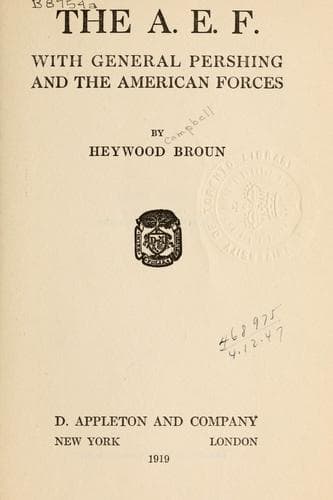
The A. E. F.: With General Pershing and the American ForcesBroun, Heywood
History
The A. E. F.: With General Pershing and the American Forces
Broun, Heywood
United States. Army. American Expeditionary Forces; World War, 1914-1918 -- Personal narratives
The navy was the first to take Paris. While the doughboys were still at
the port crowding themselves into camp, lucky sailors were on their way
to let the French capital see the American uniform. I came up on the
night train with a crowd of them. Their pockets bulged with money, tins
of salmon, ham and truffled chicken. They had chocolate in their hats
and boxes of fancy crackers under their arms, while cigars and
cigarettes poked out of their blouses. They would have nothing to do
with French tobacco, but favored a popular American brand which sells
for a quarter in New York and twice as much over here. One almost
expected each sailor to produce a roast turkey or a pheasant from up his
sleeve at meal time, but it was pretty much all meal time for these men
who were making their shore leave an intensive affair. One was a very
new sailor and he was rejoicing to find land under his feet again.
"Oh, boy!" he said, when I asked him about his ship, "that old tub had
two more movements than a hula dancer."
The little group in my compartment was sampling some champagne which
hospitable folk at the port had given them. It was not real champagne,
to be sure, but a cheaper white wine with twice as many bubbles and at
least as much noise. It sufficed very well, since it was ostentation
rather than thirst which spurred the sailors on and they spread their
hospitality throughout the train. A few French soldiers headed back for
the trenches were the traveling companions of the Americans. The poilus
were decidedly friendly but somewhat amazed at the big men who made so
much noise with their jokes and their songs. Of course the French were
called upon to sample the various tinned and bottled goods which the
sailors were carrying. It was "have a swig of this, Froggy" or "get
yourself around that, Frenchy." The Americans were still just a bit
condescending to their brothers in arms. They had not yet seen them in
action. Of course there was much comparison of equipment and the sailors
all tried on the trench helmets of the French and found them too small.
The entente grew and presently there was an allied concert. The sailors
sang, "What a Wonderful Mother You'd Make," and the French replied with
the Verdun song, "Ils Ne Passeront Pas," and later with "Madelon."
I heard that song many times afterwards and it always brings to mind a
picture of dusty French soldiers marching with their short, quick, eager
stride. They are always dusty. All summer long they wear big overcoats
which come below the knee. Dust settles and multiplies and if you see a
French regiment marching in the spring rainy season, it will still be
dusty. Perhaps their souls are a little dusty now, but it is French
dust. And as they march they sing as the men sang to the newly arrived
Americans in the train that night:
Public-domain text, read in full here on John Shaqi.
Reviews
Reviews
No reviews yet
Be the first to share your thoughts on this work.
Join the Discussion
Join the discussion
Sign in to leave a comment or review.
Sign InorCreate an account