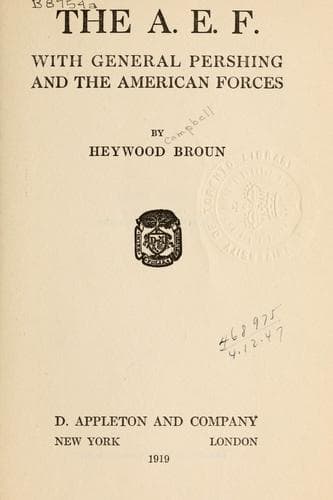
The A. E. F.: With General Pershing and the American ForcesBroun, Heywood
History
The A. E. F.: With General Pershing and the American Forces
Broun, Heywood
United States. Army. American Expeditionary Forces; World War, 1914-1918 -- Personal narratives
Later there was a man who imitated Eddie Foy imperfectly and a bad
bicycle act in which the performers called the orchestra leader
"Professor" and shouted "Ready" to each other just before missing each
trick. This bucked the Americans up so much that a lapse into French
with Suzanne Valroger "dans son repertoire" failed to annoy anybody very
much. The doughboys didn't care whether she came back with her
repertoire or on it. Some Japanese acrobats and a Swedish contortionist
completed the performance. There are two such international music halls
in Paris as well as a musical comedy of a sort called "The Good Luck
Girl." The feature of this performance is an act in which a young lady
swings over the audience and invites the soldiers to capture the shoe
dangling from her right foot. The shoe is supposed to be very lucky and
soldiers try hard to get it, standing up in their seats and snatching as
the girl swings by. An American sergeant was the winner the night I went
to the show, for he climbed upon a comrade's shoulder and had the
slipper off before the girl had time to swing out very far. Later, when
he went to the trenches, the sergeant took the shoe with him and he says
that up to date he has no reason to doubt the value of the charm.
The most elaborate spectacle inspired by the coming of the Americans was
at the Folies Bergères which sent its chorus out for the final number
all spangled with stars. The leader of the chorus was an enormous woman,
at least six feet tall, who carried an immense American flag. She almost
took the head off a Canadian one night as he dozed in a stage box and
failed to notice the violent manner in which the big flag was being
swung. He awoke just in time to dodge and then he shook an accusing
finger at the Amazon. "Why aren't you in khaki?" he said.
Restaurants as well as theaters were liberally sprinkled with men in the
American uniform. The enlisted men ate for the most part in French
barracks and seemed to fare well enough, although one doughboy, after
being served with spinach as a separate course, complained: "I do wish
they'd get all the stuff on the table at once like we do in the army. I
don't want to be surprised, I want to be fed." A young first lieutenant
was scornful of French claims to master cookery. "Why, they don't know
how to fry eggs," he said. "I've asked for fried eggs again and again
and do you know what they do? They put 'em in a little dish and bake
'em."
Yet, barring this curious and barbarous custom in the cooking of eggs,
the French chefs were able to charm the palates of Americans even in a
year which bristled with food restrictions. There were two meatless days
a week, sugar was issued in rations of a pound a month per person and
bread was gray and gritty. The French were always able to get around
these handicaps. The food director, for instance, called the ice cream
makers together and ordered them to cease making their product in order
to save sugar.
Public-domain text, read in full here on John Shaqi.
Reviews
Reviews
No reviews yet
Be the first to share your thoughts on this work.
Join the Discussion
Join the discussion
Sign in to leave a comment or review.
Sign InorCreate an account