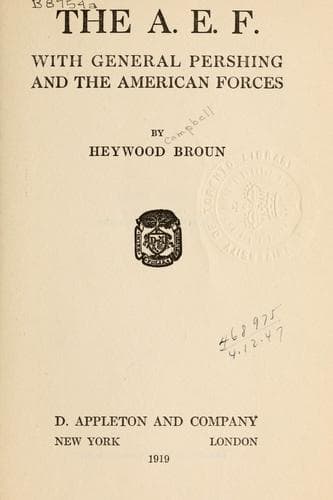
The A. E. F.: With General Pershing and the American ForcesBroun, Heywood
History
The A. E. F.: With General Pershing and the American Forces
Broun, Heywood
United States. Army. American Expeditionary Forces; World War, 1914-1918 -- Personal narratives
Still it was not possible to regulate romance entirely out of existence.
"There was a girl used to pass my car every morning," said a sergeant
chauffeur, "and she was so good looking that I got a man to teach me
_'bon jour,'_ and I used to smile at her and say that when she went by
and she'd say _'bon jour'_ and smile back. One morning I got an apple
and I handed it to her and said '_pour vous_' like I'd been taught. She
took it and came right back with, 'Oh, I'm ever so much obliged,' and
there like a chump I'd been holding myself down to '_bon jour_' for two
weeks."
There could be no question of the devotion of Paris to the American
army. Indeed, so rampant was affection that it was occasionally
embarrassing. One officer slipped in alighting from the elevator of his
hotel and sprained his ankle rather badly. He was hobbling down one of
the boulevards that afternoon with the aid of a cane when a large
automobile dashed up to the curb and an elderly French lady who was the
sole occupant beckoned to him and cried: "_Premier blessé_." The officer
hesitated and a man who was passing stepped up and said: "May I
interpret for you?" The officer said he would be much obliged. The
volunteer interpreter talked to the old lady for a moment and then he
turned and explained: "Madame is desirous of taking you in her car
wherever you want to go, because she says she is anxious to do something
for the first American soldier wounded on the soil of France."
The devotion of Paris was so obvious that it palled on one or two who
grew fickle. I saw a doughboy sitting in front of the Café de la Paix
one bright afternoon. He was drinking champagne of a sort and smoking a
large cigar. The sun shone on one of the liveliest streets of a still
gay Paris. It was a street made brave with bright uniforms. Brighter
eyes of obvious non-combatants gazed at him with admiration. I was
sitting at the next table and I leaned over and asked: "How do you like
Paris?"
He let the smoke roll lazily out of his mouth and shook his head. "I
wish I was back in El Paso," he said.
I found another soldier who was longing for Terre Haute. Him I came upon
in the lounging room of a music hall called the Olympia. Two palpably
pink ladies sat at the bar drinking cognac. From his table a few feet
away the American soldier looked at them with high disfavor. Surprise,
horror and indignation swept across his face in three waves as the one
called Julie began to puff a cigarette after giving a light to Margot.
He looked away at last when he could stand no more, and recognizing me
as a fellow countryman, he began his protest.
Public-domain text, read in full here on John Shaqi.
Reviews
Reviews
No reviews yet
Be the first to share your thoughts on this work.
Join the Discussion
Join the discussion
Sign in to leave a comment or review.
Sign InorCreate an account