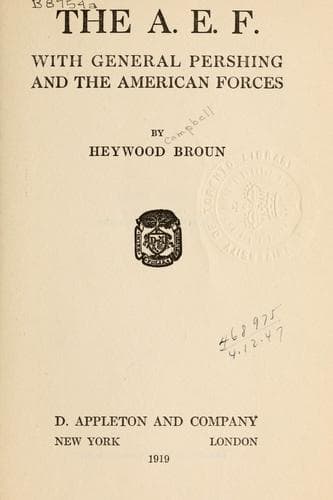
The A. E. F.: With General Pershing and the American Forces — John Shaqi
The A. E. F.: With General Pershing and the American ForcesBroun, Heywood
History
The A. E. F.: With General Pershing and the American Forces
Broun, Heywood
United States. Army. American Expeditionary Forces; World War, 1914-1918 -- Personal narratives
They had been with us not a little from the beginning. Even on the first
day out from New York the ship ran with all lights out and portholes
shielded. Later passengers were forbidden to smoke on deck at night and
once there was a lifeboat drill of a sort, but the boats were not swung
out in the davits until after we met the submarine.
Early in the voyage an old lady complained to the purser because a young
man in the music room insisted on playing the Dead March from "Saul."
There was more cheerful music. The ambulance drivers saw to that. We had
an Amherst unit and one from Leland Stanford and the boys were nineteen
or thereabouts. It is well enough to say that all the romance has gone
out of modern war, but you can't convince a nineteen-year-older of that
when he has his first khaki on his back and his first anti-typhoid
inoculation in his arm. They boasted of these billion germs and they
swaggered and played banjos and sang songs. Mostly they sang at night on
the pitch black upper deck. The littlest ambulance driver had a nice
tenor voice and on still nights he did not care what submarine commander
knew that he "learned about women from her." He and his companions
rocked the stars with "She knifed me one night." Daytimes they studied
French from the ground up. It was the second day out that I heard a
voice from just outside my porthole inquire "E-S-T--what's that and how
do you say it?" Later on the littlest ambulance driver had made marked
progress and was explaining "Mon oncle a une bonne fille, mais mon père
est riche."
Romance was not hard to find on the vessel. The slow waiter who limped
had been wounded at the Marne, and the little fat stewardess had spent
twenty-two days aboard the German raider _Eitel Friedrich_. There were
French soldiers in the steerage and one of them had the Croix de Guerre
with four palms. He had been wounded three times.
But when the ship came up the river the littlest ambulance driver--the
one who knew "est" and women--summed things up and decided that he was
glad to be an American. He looked around the deck at the Red Cross
nurses and others who had stood along the rail and cheered in the
submarine fight, and he said:
"I never would have thought it of 'em. It's kinda nice to know American
women have got so much nerve."
The littlest ambulance driver drew himself up to his full five feet four
and brushed his new uniform once again.
"Yes, sir," he said, "we men have certainly got to hand it to the girls
on this boat." And as he went down the gangplank he was humming: "And I
learned about women from her."
CHAPTER II
THE A. E. F.
The dawn was gray and so was the ship, but the eye picked her out of the
mist because of two broad yellow stripes which ran the whole length of
the upper decks. As the ship warped into the pier the stripes of yellow
became so many layers of men in khaki, each motionless and each gazing
toward the land.
Public-domain text, read in full here on John Shaqi.
Reviews
Reviews
No reviews yet
Be the first to share your thoughts on this work.
Join the Discussion
Join the discussion
Sign in to leave a comment or review.
Sign InorCreate an account