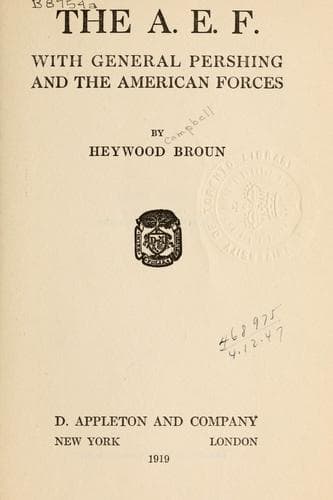
The A. E. F.: With General Pershing and the American ForcesBroun, Heywood
History
The A. E. F.: With General Pershing and the American Forces
Broun, Heywood
United States. Army. American Expeditionary Forces; World War, 1914-1918 -- Personal narratives
I do not wish to imply that the men who come up from the ranks do not
make good officers. As a matter of fact they are among the best, once
their preliminary self-consciousness has worn off. The transition from
stripes to bars is perfect torture to some of them. One company had a
crack soldier who had been a sergeant for seven years. He was
recommended for promotion and was sent to an officers' training school
in France. He did very well but just a week before he was to receive his
commission he succeeded in gaining permission to be dropped from the
school and go back to his old company as sergeant. At the last minute he
had decided that he did not want to be an officer.
I watched him put a company through its drill two days after his return.
They moved with spirit and precision under his commands but when it was
all over I found one reason why he didn't want to be an officer.
"That was very good today," he said. "You done well."
The first lieutenant smiled. He had a right to smile, too, for the
return of the sergeant to his company had almost cut his work in half.
He knew his value well enough.
"The best I can do is teach the men," he said. "It takes an old sergeant
to learn them."
CHAPTER VIII
MEN WITH MEDALS
General Pétain was the first of many famous Frenchmen who came to see
the American troops in training. He also had the additional object of
reviewing the chasseurs and of distributing medals, for this crack
division had been withdrawn from one of the most active sectors to
instruct the doughboys. General Pershing accompanied Pétain. The blue
devils were drawn up in formation in the middle of a big meadow cupped
within hills. The seven men who were to be honored stood in a line in
front of the division. Six were officers and they awaited the pleasure
of the general with their swords held at attention. The seventh man who
stood at the right of the little line was an old sergeant with a great
flowing gray and white mustache. The rifle which he held in front of him
overtopped him by at least a foot.
The ceremony began with a fanfare by the trumpeters. As the last notes
came tumbling back from the hills Pétain moved forward. We found that he
was not so tall as Pershing nor quite as straight. The French leader is
also a little gray and about his waist there is just a suggestion of the
white man's burden. But he is soldierly for all that and his eyes are
marvelously keen and steady. His tailor deserved a decoration. The
general wore only one medal, but that was as large as the badge of a
country sheriff. It was a great silver shield hung about his neck and
indicated that he was a commander of the Legion of Honor. He stopped in
front of the first officer in the little line waiting to be honored and
spoke to him for a moment. Then he pinned a red ribbon on his coat and
kissed the man first on the left cheek and then on the right. The
doughboys looked on in amazement.
"Well, I'll be damned," said one under his breath, "it's true."
Public-domain text, read in full here on John Shaqi.
Reviews
Reviews
No reviews yet
Be the first to share your thoughts on this work.
Join the Discussion
Join the discussion
Sign in to leave a comment or review.
Sign InorCreate an account