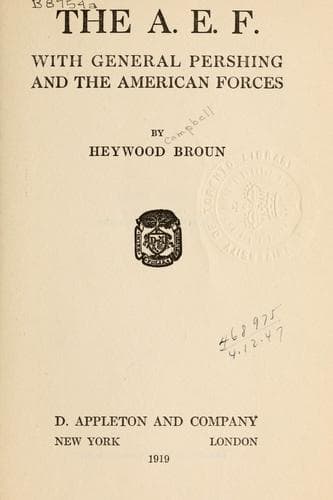
The A. E. F.: With General Pershing and the American ForcesBroun, Heywood
History
The A. E. F.: With General Pershing and the American Forces
Broun, Heywood
United States. Army. American Expeditionary Forces; World War, 1914-1918 -- Personal narratives
At first the ace is low. Our young aviators who will be among the most
romantic heroes of them all begin humbly on the ground. The American
army now has the largest flying field in France for its very own, but
during summer and early autumn many of our men trained in the French
schools. There his groundling days try the aviator's dignity. He must
hop before he can fly and perhaps "hop" is too dignified a word. When we
visited one of the biggest schools, all the new pupils were practicing
in a ridiculous clipped wing Bleriot called a penguin. This machine was
a groundhog which scurried over the earth at a speed of twenty or thirty
miles an hour. It never left the grass tops and yet it provided a
certain amount of excitement for its pilot, or maybe rider would be
better.
The favorite trick of the penguin is to turn suddenly in a short half
circle and collapse on its side. It takes a good deal of skill to keep
it straight and when the aviator has learned that much he is allowed to
make a trip in a machine which leaps a little in the air every now and
then, only to flop to earth again. Then he is ready to fly a Bleriot,
though, of course, his first trips are made as a passenger. Very little
time is spent in flying. Staying up in the air is no great trick. It's
the coming down which gives the trouble. And so the student is eternally
trying landings. He smashes a good many machines and here the French
show their keen realization of the mental factor in flying.
"I made a bad landing one day," an American student named Billy Parker
told me, "and smashed my machine up good and proper. I thought I'd
killed myself, but they dragged me out from under the junk, picked the
pieces of wood and aluminum out of my head, stuffed some cotton into my
nose to check the bleeding and in fifteen minutes they had a new machine
out and had me up in the air again."
Parker said he felt a bit queer when he got up in the air again. "I had
a sort of feeling that I belonged down on the ground and not up there,"
he said. "That was peculiar because usually the air feels very stable
and friendly. You hate to come down, but this time I was anxious to get
back and after circling the field once I came down. My landing was all
right, too, and since then I've never had that scared feeling about the
air."
The French theory is that the mistake must be corrected immediately. The
man who has had a smash-up is apt to get air shy if he has a chance to
brood over his mishap for a day or two.
Public-domain text, read in full here on John Shaqi.
Reviews
Reviews
No reviews yet
Be the first to share your thoughts on this work.
Join the Discussion
Join the discussion
Sign in to leave a comment or review.
Sign InorCreate an account