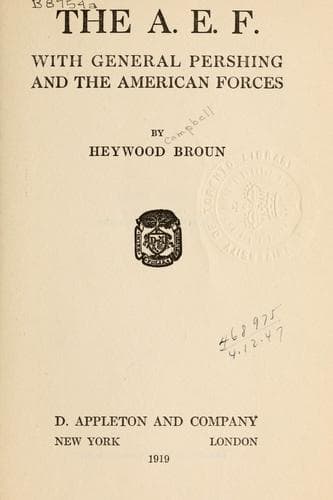
The A. E. F.: With General Pershing and the American Forces — John Shaqi
The A. E. F.: With General Pershing and the American ForcesBroun, Heywood
History
The A. E. F.: With General Pershing and the American Forces
Broun, Heywood
United States. Army. American Expeditionary Forces; World War, 1914-1918 -- Personal narratives
A French soldier came up then and expostulated. He said that we must not
talk to the Germans and set his prisoners back to their task of lifting
rails. There were guards at both ends of the street, but scores of
children slipped by them and began to talk to the soldiers. There were
hardly half a dozen men in the first regiment who understood French.
Veterans of the Mexican border tried a little bad Spanish and when that
didn't work they fell back to signs. The French made an effort to meet
the visitors half way. I saw a boy extend his reader to a soldier and
explain that a fearfully homely picture which looked like a caterpillar
was a "chenille." The boy added that the chenille was so ugly that it
was without doubt German and no good. Children also pointed out familiar
objects in the book such as "Chats" and "Chiens," but as one soldier
said: "I don't care about those things, sonny: haven't you got a roast
chicken or an apple pie in that book?"
Some officers had tried to teach their men a little French on the trip
across, but not much seemed to stick. The men were not over curious as
to this strange language. One old sergeant went to his lieutenant and
said: "You know, sir, I've served in China and the Philippines and Cuba.
I've been up against this foreign language proposition before and I know
just what I need. If you'll write down a few words for me and tell me
how they're pronounced I won't have to bother you any more. I want 'Give
me a plate of ham and eggs. How much? What's your name?' and 'Do you
love me, kid?'"
The vocabulary of the officers did not seem very much more extensive
than that of the men. While the troops were disembarking officers were
striving to get supplies started for the camp several miles outside the
city. All the American motor trucks had been shipped on the slowest
steamer of the convoy but the French came to our aid. "I have just one
order," said the French officer, who met the first unit of the American
Expeditionary Army, "there is no American and no French now. There is
only ours."
Although the officer was kind enough to make ownership of all available
motor trucks common, he could not do as much for the language of the
poilus who drove them. I found the American motor truck chief hopelessly
entangled.
Public-domain text, read in full here on John Shaqi.
Reviews
Reviews
No reviews yet
Be the first to share your thoughts on this work.
Join the Discussion
Join the discussion
Sign in to leave a comment or review.
Sign InorCreate an account