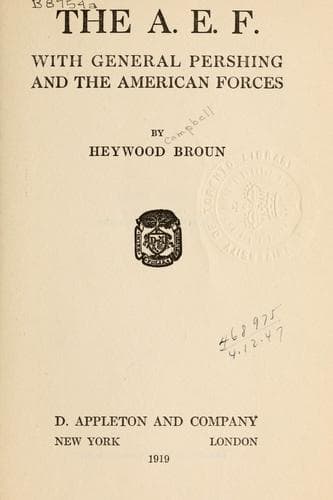
The A. E. F.: With General Pershing and the American ForcesBroun, Heywood
History
The A. E. F.: With General Pershing and the American Forces
Broun, Heywood
United States. Army. American Expeditionary Forces; World War, 1914-1918 -- Personal narratives
Crossing the square we went into the office of _L'Eclaireur de l'Est_.
This daily newspaper has no humorous column, no editorials, no sporting
page and no dramatic reviews, and yet is probably the most difficult
journal in the world to edit. The chief reportorial task of the staff of
_L'Eclaireur_ is to count the number of shells which fall into the city
each day. That doesn't sound hard. The reporter can hear them all from
his desk and many he can see, for the cathedral just across the street
is still the favorite target of the Germans. Sometimes the reporter does
not have to look so far. The office of _L'Eclaireur_ has been hit eleven
times during the bombardment and three members of the staff have been
killed. One big shell fell in the composing room and so now the paper
is set by hand. It is a single sheet and the circulation is limited to
the three or four thousand civilians, who have stuck to Rheims
throughout the bombardment. One of the few who remain is a man who keeps
a picture postcard shop in a building next door to the newspaper office.
His roof has been knocked down about his head and his business is hardly
thriving. I asked him why he remained.
"I started to go away several months ago after one day when they put
some gas shells into the town," he said. "The very next morning I put
all my things into a cart and started up that street there. I had gone
just about to the third street when a shell hit the house behind me. It
killed my horse and wrecked the wagon and so I picked up my things and
came back. It seemed to me I wasn't meant to go away from Rheims."
The shelling increased in violence before we left the office of
_L'Eclaireur_. One shell was certainly not more than a hundred and fifty
yards away, but the work went on without interruption. The printers who
were setting ads never looked up. Mostly these advertisements were of
houses in Rheims which were renting lower than ever before. If there was
anyone in the visiting party who felt uncomfortable he was unwilling to
show it, for just outside the door of the newspaper office there sat an
old lady with a lapful of fancy work. A shell came from over the hills
and, in the seconds while it whistled and then smashed, the old lady
threaded her needle.
A day later, when some of us were willing to confess that of all
miserable sounds the whistling of a shell was the meanest, we found a
curious kink in the brain of everyone. It was the universal experience
that the slightest bit of cover, however inadequate, gave a sense of
safety out of all proportion to its utility. Thus we all felt much more
uncomfortable in the square than when we stood in the composing room of
the newspaper which was shielded by the remains of a glass skylight. The
same curious psychological twist can be found among soldiers at the
front. Again and again men will be found taking apparent comfort in the
fact that half an inch of tin roof protects them from the shells of the
Germans.
Public-domain text, read in full here on John Shaqi.
Reviews
Reviews
No reviews yet
Be the first to share your thoughts on this work.
Elsewhere in the archive
Join the Discussion
Join the discussion
Sign in to leave a comment or review.
Sign InorCreate an account