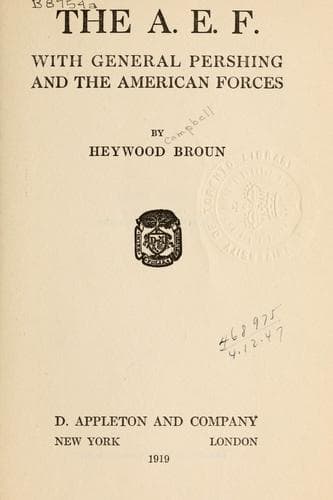
The A. E. F.: With General Pershing and the American ForcesBroun, Heywood
History
The A. E. F.: With General Pershing and the American Forces
Broun, Heywood
United States. Army. American Expeditionary Forces; World War, 1914-1918 -- Personal narratives
"I censored his stuff," said another. "I didn't think much of it, but I
made almost no changes. Some of it was a little subtle, but I let it get
by."
"I heard him out here," said a third officer, "and he talked no end of
rot. He said the Germans had made a botch of destroying towns. He said
he could have done more damage to Arras with a hammer than the Germans
did with their shells. Of course, he couldn't begin to do it with a
hammer, and, anyway, he wouldn't be let. I suppose he never thought of
that. Then he said that the Germans were doing us a great favor by their
air raids. He said they were smashing up things that were ugly and
unsanitary. That's silly. We could pull them down ourselves, you know,
and, anyhow, in the last raid they hit the postoffice."
"The old boy's got nerve, though," interrupted another officer. "I was
out at the front with him near Arras and there was some pretty lively
shelling going on around us. I told him to put on his tin hat, but he
wouldn't do it. I said, 'Those German shell splinters may get you,' and
he laughed and said if the Germans did anything to him they'd be mighty
ungrateful, after all he'd done for them. He don't know the Boche."
"He told me," added a British journalist, "'when I want to know about
war I talk to soldiers.' I asked him: 'Do you mean officers or Tommies?'
He said that he meant Tommies.
"Now you know how much reliance you can put in what a Tommy says. He'll
either say what he thinks you want him to say or what he thinks you
don't want him to say. I told Shaw that, but he paid no attention."
Here the first officer chimed in again. "Well, I stick to what I've said
right along. I don't see where Shaw's funny. I think he's silly."
The major who sat at the head of the table deftly turned the
conversation away from literary controversy. "What did you think of
Conan Doyle?" he said.
* * * * *
Bright and early next morning we started out to follow in the footsteps
of Shaw. We went through country which had been shocked and shaken by
both sides in their battles and then dynamited in addition by the
retreating Germans. I stood in Peronne which the Germans had dynamited
with the greatest care. They left the town for dead, but against a
shattered wall was a sign which read, "Regimental cinema tonight at the
Splinters--CHARLIE CHAPLIN IN SHANGHAIED." This was first aid. A frozen
man is rubbed with snow and a town which has suffered German
frightfulness is regaled with Charlie Chaplin.
Public-domain text, read in full here on John Shaqi.
Reviews
Reviews
No reviews yet
Be the first to share your thoughts on this work.
Elsewhere in the archive
Join the Discussion
Join the discussion
Sign in to leave a comment or review.
Sign InorCreate an account