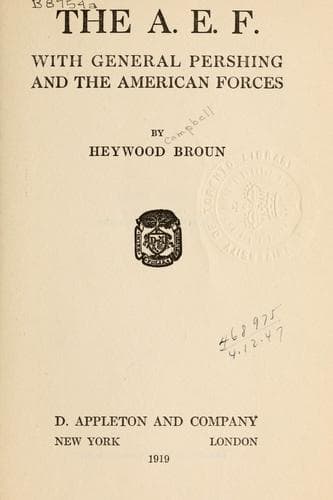
The A. E. F.: With General Pershing and the American ForcesBroun, Heywood
History
The A. E. F.: With General Pershing and the American Forces
Broun, Heywood
United States. Army. American Expeditionary Forces; World War, 1914-1918 -- Personal narratives
Life will come back to that town in time and to others. After all life
is a rubber band and it will be just as it was only an instant after
they let go. We turned down the road to Arras and drove between fields
which had been burned to cinders and trodden into mud by men and guns
only a few weeks ago. Now the poppies were sweeping all before them.
Into the trenches they went and over. First line, second line, third
line, each fell in turn to the redcoats. They were so thick that the
earth seemed to bleed for its wounds.
Presently we were in Arras and our officer led us into the cathedral.
"We won't stay in here long," said the officer. "The Germans drop a
shell in here every now and then and the next one may bring the rest of
the walls down. People keep away from here." This indeed seemed a very
citadel of destruction and loneliness, but as we turned to go we heard a
mournful noise from an inner room. We investigated and found a Tommy
practicing on the cornet. He was playing a piece entitled, "Progressive
Exercises for the Cornet--Number One." He stood up and saluted.
"Have the Germans bombarded the town at all today?" the captain asked.
"Yes, sir," said the Tommy. "They bombarded the square out in front here
this morning."
"Did they get anybody?"
"No, sir, only a Frenchman, sir," replied the Tommy with stiff
formality.
"Was there any other activity?"
"Yes, sir, there were some aeroplanes over about an hour ago and they
dropped some bombs in there," said the Tommy indicating a street just
back of the cathedral.
"And what were we doing?" persisted the captain.
"We were trying out some new anti-aircraft ammunition," explained the
Tommy patiently, "but I don't think it was any good, sir, because most
of it came down and buried itself over there," and he indicated a spot
some fifteen or twenty feet from his music room.
The captain could think of no more inquiries just then and the soldier
quickly folded up his cornet and his music and after saluting with
decent haste left the cathedral. For the sake of his music he was
willing to endure shells and bombs and shrapnel fragments but questions
put him off his stride entirely. He fled, perhaps, to some shell hole
for solitude.
From the cathedral we went to the town hall. Here again one could not
but be impressed with the futility of destruction. The Germans have torn
the building cruelly with their shells and their dynamite, but beauty is
tough. Dynamite a bakeshop and you have only a mess. Shell a tailor's
and rubbish is left. But it is different when you begin to turn your
guns against cathedrals and town halls. If a structure is built
beautifully it will break beautifully. The dynamite has cut fine lines
in the jagged ruins of the Town Hall. The Germans have smashed
everything but the soul of the building. They didn't get that. It was
not for want of trying, but dynamite has its limitations.
Public-domain text, read in full here on John Shaqi.
Reviews
Reviews
No reviews yet
Be the first to share your thoughts on this work.
Elsewhere in the archive
Join the Discussion
Join the discussion
Sign in to leave a comment or review.
Sign InorCreate an account