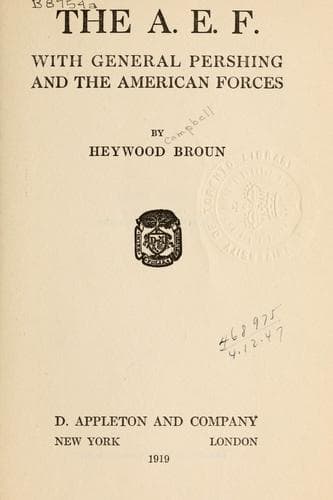
The A. E. F.: With General Pershing and the American ForcesBroun, Heywood
History
The A. E. F.: With General Pershing and the American Forces
Broun, Heywood
United States. Army. American Expeditionary Forces; World War, 1914-1918 -- Personal narratives
"If they get the balloon does that mean that they get the observer?" I
asked in my ignorance.
"Lord bless you no," said the soldier. "No danger for 'im, sir. He just
jumps out with a parachute."
Next we turned our attention to the big gun firing. We could see the
flash of the guns of both sides and hear the whistle of the shells.
After the flash one might mark the result if he had a sharp eye. There
was no trouble in following the progress of one particular British shell
for an instant after the flash a high column of smoke arose above a town
which the Germans held. A minute or so later we had our own column for a
German shell hit one of the many munition dumps scattered about behind
the British front. Our own hill was pocked with shell holes and the
tower near which we stood was nibbled nigh to bits and we had a wakeful,
stimulating feeling that almost any minute something might drop on or
near us. The Tommy with whom we shared the view undeceived us.
"This hill!" he said. "Why there was a time when it was as much as your
life was worth to stand up here and now the place's nothing but a
bloomin' Cook's tour resort."
Our last day with the army was spent at the University of Death and
Destruction where the men from England take their final courses in
warfare. We began with a class which was having a lesson in defense
against bombs. A tin can exploded at the feet of a Scotchman and
peppered his bare legs. Five hundred soldiers roared with laughter, for
the man in the kilt had flunked his recitation in "Trench Raiding."
Officially the Scot was dead, for the tin can represented a German bomb.
They were cramming for war in the big training camp and they played
roughly. The imitation bombs carried a charge of powder generous enough
to insure wholesome respect. The Scot, indeed, had to retire to have a
dressing made.
The trench in which the class was hard at work was perfect in almost
every detail, save that it lacked a back wall. This was removed for the
sake of the audience. An instructor stood outside and every now and
again he would toss a bomb at his pupils. He played no favorites. The
good and the bad scholar each had his chance. In order to pass the
course the soldier had to show that he knew what to do to meet the bomb
attack. He might take shelter in the traverse; he might kick the bomb
far away; or, with a master's degree in view, he might pick up the
imitation bomb and hurl it far away before it could explode. Speed and
steady nerves were required for this trick. An explosion might easily
blow off a finger or two. Yet, after all, it was practice. Later there
might be other bombs designed for bigger game than fingers.
Public-domain text, read in full here on John Shaqi.
Reviews
Reviews
No reviews yet
Be the first to share your thoughts on this work.
Elsewhere in the archive
Join the Discussion
Join the discussion
Sign in to leave a comment or review.
Sign InorCreate an account